


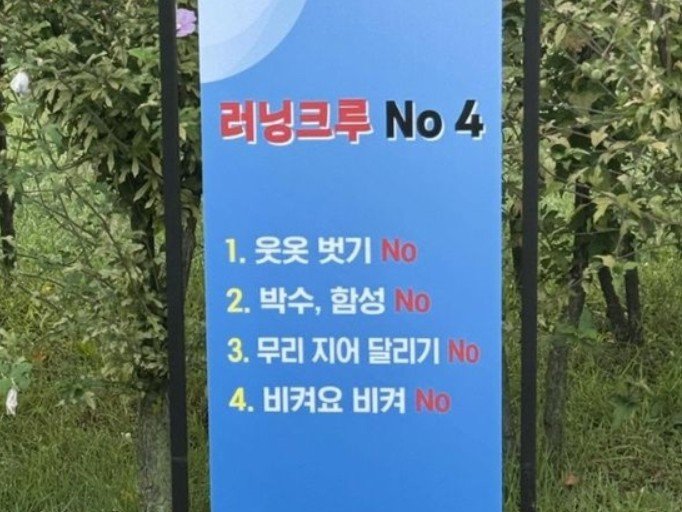
Shirtless runners at Han River spark debate on public decency vs. personal freedom
Translated from Korean, summarized and contextualized by DistantNews.
At a glance
News
Sources not specified
Context piece
- A debate is ongoing in Seoul's Han River parks between public decency advocates and those defending personal freedom regarding men running shirtless.
- While signs and announcements prohibit topless running, some runners ignore them, causing discomfort to other park users, especially women and children.
- Authorities face challenges in enforcing rules, as there is no current law penalizing or fining individuals for running shirtless outdoors.
A debate is unfolding along Seoul's Han River, pitting concerns for public decency against claims of personal freedom, specifically concerning men running shirtless. While the scenic park paths are popular for recreation, the sight of topless male runners has sparked controversy among park visitors.
Signs posted along the Han River park's walking and running trails explicitly prohibit running without a shirt, emphasizing the need for runners to adhere to rules and avoid causing discomfort to others. Public address announcements also periodically remind users to be considerate. Despite these measures, some runners continue to run shirtless, disregarding the posted guidelines and public announcements.
In a public place, it feels a bit embarrassing for young children or women to see.
Many park users express discomfort and embarrassment, particularly citing the presence of children and women. They argue that running shirtless in a public space is inappropriate and violates basic public etiquette. The sentiment is that such behavior creates an uncomfortable atmosphere for families and other visitors seeking to enjoy the park.
It's too much to restrict taking off clothes while exercising outdoors in hot weather.
Conversely, a segment of the public defends the practice as an exercise of personal freedom. They argue that in hot weather, removing one's shirt is a natural way to regulate body temperature and enhance exercise efficiency. Online discussions reveal opinions that restricting this behavior is excessive, with some questioning the extent of personal freedom in South Korea. Proponents believe that as long as the activity does not harm others, it should not be excessively regulated.
Adding to the complexity, administrative agencies find it difficult to directly intervene. Current laws do not provide a legal basis to punish or impose fines on individuals for running shirtless in outdoor public spaces. This lack of legal recourse leaves authorities in a challenging position, unable to definitively resolve the conflict between differing views on public behavior and individual liberty.
Does this country have no freedom?
DistantNews Editorial
Originally published by Dong-A Ilbo in Korean. Translated, summarized, and contextualized by our editorial team with added local perspective. Read our editorial standards.
More Stories


From Our Blog

What Gets Lost (and Found) When News Is Translated

The Critical Role of Diaspora Media in Global News

What Travellers Should Know About Countries with Restricted Press

A Digital Nomad's Guide to Following Local News

How the Same Story Looks Different in Different Countries
