


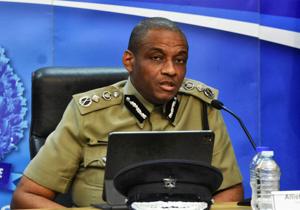
Should CoP recuse himself in intelligence review?
Summarized and contextualized by DistantNews.
At a glance
News
Sources not specified
Under investigation
- Attorneys are asking the Police Service Commission to determine if the Commissioner of Police should recuse himself from reviewing the country's intelligence and communications interception framework.
- They also requested an independent review mechanism to examine compliance with mandatory reporting obligations under the Strategic Services Agency Act and the Interception of Communications Act.
- The lawyers noted that annual reports required under these acts appear not to have been laid before Parliament for several years, raising concerns about statutory safeguards.
Attorneys representing Rajaee Ali, Earl Richards, and Christopher Hughes have formally requested the Police Service Commission (PolSC) to consider whether the Commissioner of Police should recuse himself from any investigation or review concerning alleged statutory non-compliance within Trinidad and Tobago's intelligence and communications interception framework. The legal team also called for the establishment of an independent review mechanism.
In a letter dated July 16, Quantum Legal attorneys Criston J Williams and Blaine Sobrian addressed their concerns to PolSC chairman Dr. Wendell Wallace and Director of Public Prosecutions Roger Gaspard, SC. Their clients have been directly impacted by executive actions where intelligence, national security considerations, or information derived from covert statutory powers were relied upon by public authorities. This reliance was cited in the transfer of Ali and Richards during a state of emergency and in criminal proceedings against Hughes, which involved national security and alleged communications with certain individuals.
The attorneys clarified they are not challenging intelligence gathering or intelligence-led policing, nor are they alleging unlawful communication interception. Their primary concern lies with whether the institutions entrusted with these powers have adhered to parliamentary safeguards and whether established accountability mechanisms have lapsed without explanation. Specifically, they highlighted that annual reports required under Section 13 of the Strategic Services Agency Act and Section 24 of the Interception of Communications Act appear not to have been submitted to Parliament for several years.
Correspondence seeking clarification on these reporting obligations, sent to various public officials since 2024, has yielded responses confirming that while annual reports were prepared and delivered to the minister responsible for national security in at least one instance, they were not subsequently laid before Parliament. The attorneys argue that these reporting requirements serve as mandatory statutory safeguards, and their apparent lapse raises significant questions about regulatory oversight.
DistantNews Editorial
Originally published by Trinidad Express. Summarized and contextualized by our editorial team with added local perspective. Read our editorial standards.
More Stories

From Our Blog

What Gets Lost (and Found) When News Is Translated

The Critical Role of Diaspora Media in Global News

What Travellers Should Know About Countries with Restricted Press

A Digital Nomad's Guide to Following Local News

How the Same Story Looks Different in Different Countries
