


Singapore graduates may need to lower salary expectations amid economic uncertainty: Analysts
Translated from English, summarized and contextualized by DistantNews.
At a glance
News
Official statement
Context piece
- Fresh university graduates in Singapore may need to lower salary expectations due to economic uncertainty, according to analysts.
- A Ministry of Manpower survey found that about 30.6% of graduates rejected job offers because the wages were too low.
- Graduates in fields like IT, engineering, and business earned less than they anticipated, while law and education graduates met or exceeded expectations.
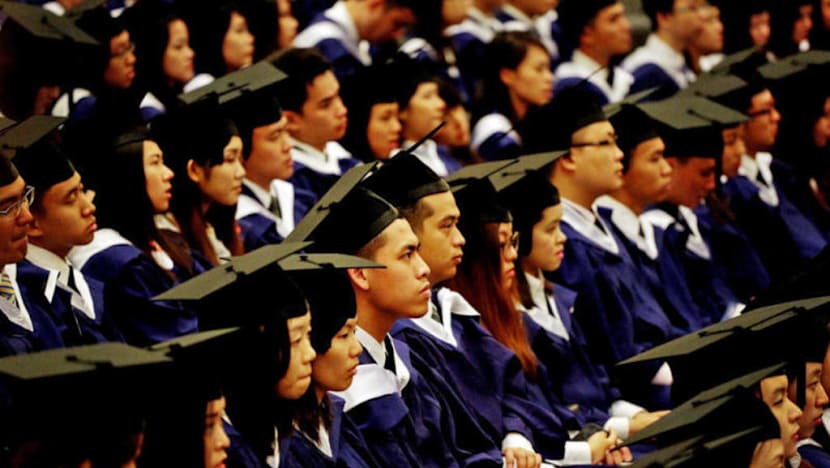
Fresh university graduates in Singapore might need to adjust their salary expectations as wage growth is predicted to be uneven across sectors this year, influenced by global economic uncertainty. A recent Ministry of Manpower (MOM) study, the School-to-Work Transition Study, revealed that graduates across most disciplines received lower salaries than they had anticipated upon entering the workforce.
The 2025 survey polled approximately 2,500 Singaporean resident graduates aged 22 to 28 with bachelor's degrees. It investigated their employment outcomes and early career experiences, including salary expectations, to better understand the transition from education to employment. The study identified low pay as the primary reason for rejecting job offers, cited by 30.6% of respondents. Another 26.7% were holding out for better offers, while other factors included lack of job interest, unsuitable work environments, and limited career advancement opportunities.
I think it speaks of the fact that they are all very pragmatic – in other words, quite realistic overall.
Analysts suggest these findings reflect the pragmatic priorities of today's young jobseekers. Professor Lawrence Loh from the NUS Business School noted that graduates are "quite realistic overall." He also pointed to the rising cost of living as a potential influence on their expectations. "For graduates, it is very important to start at the point as high as possible, because sometimes wages are sticky… To get (an) increment is quite difficult, so when your starting point is high, it’s easy to move upwards,” Prof Loh explained.
The MOM survey highlighted significant salary gaps for many graduates. For instance, IT graduates earned a median monthly salary of S$5,150 (US$4,020), falling short of their expected S$6,000. Engineering graduates earned S$4,450, below their expected S$5,000, and business and administration graduates received S$4,000 against expectations of S$5,000. Natural and mathematical sciences graduates had a median wage of S$3,700, compared to an expected S$5,000. Only graduates in law, education, fine, and applied arts reported salaries that met or exceeded their expectations.
Also, for graduates, it is very important to start at the point as high as possible, because sometimes wages are sticky … To get (an) increment is quite difficult, so when your starting point is high, it’s easy to move upwards.
DistantNews Editorial
Originally published by CNA in English. Translated, summarized, and contextualized by our editorial team with added local perspective. Read our editorial standards.
More Stories



From Our Blog

What Gets Lost (and Found) When News Is Translated

The Critical Role of Diaspora Media in Global News

What Travellers Should Know About Countries with Restricted Press

A Digital Nomad's Guide to Following Local News

How the Same Story Looks Different in Different Countries
