


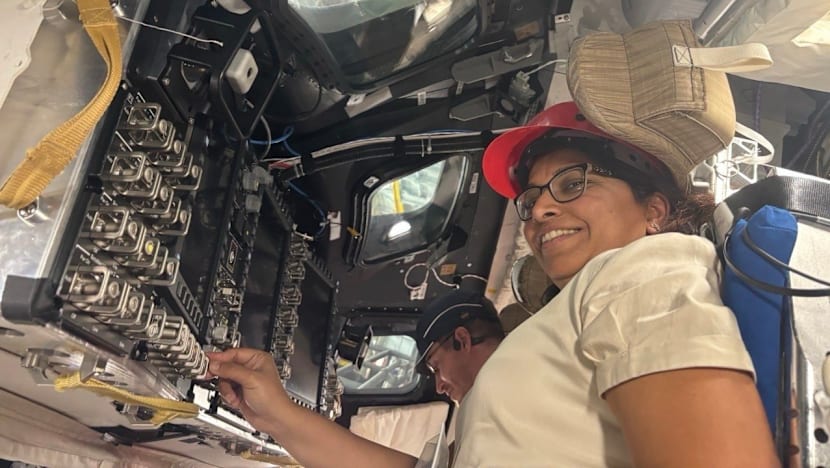
Singaporean engineer's work went to the moon and back on Artemis II mission
Translated from English, summarized and contextualized by DistantNews.
At a glance
In-depth
Named sources
Outcome reported
- Singaporean Lalita Devi Arjun Singh was part of the team that developed a health monitoring kit for NASA's Artemis II mission.
- The kit analyzed astronauts' stress and immune system function during their journey around the moon.
- Singh also helped develop emergency nutrition pouches, contributing to astronaut safety and future space exploration.
Singaporean Lalita Devi Arjun Singh played a key role in developing a health monitoring kit used by astronauts on NASA's Artemis II mission, which recently completed its journey around the moon. This mission marked the first human travel to the moon's vicinity in over 50 years.
As project manager at the science and technology company Leidos, Singh co-led a five-member team that created a dry saliva collection kit. This kit allowed scientists to analyze how astronauts' bodies responded to microgravity and confined spaces during the 10-day mission. The data gathered helps in developing countermeasures to protect astronaut health for future long-duration missions to the moon and Mars.
In addition to the health monitoring kit, Singh also contributed to developing specialized nutrition and hydration pouches in 2024. These pouches are designed for contingency situations, such as sudden pressure drops within the spacecraft caused by leaks or micro-meteoroid strikes. They contain chocolate and vanilla powder and can be mixed with water to provide essential sustenance when astronauts are unable to eat normally.
This helps scientists understand how the crew’s bodies react differently during space travel when experiencing microgravity in a confined space, and to develop countermeasures to protect astronauts’ health and prevent illness for future long missions to the moon, Mars and beyond.
DistantNews Editorial
Originally published by CNA in English. Translated, summarized, and contextualized by our editorial team with added local perspective. Read our editorial standards.
More Stories



From Our Blog

What Gets Lost (and Found) When News Is Translated

The Critical Role of Diaspora Media in Global News

What Travellers Should Know About Countries with Restricted Press

A Digital Nomad's Guide to Following Local News

How the Same Story Looks Different in Different Countries
