


SK Group to invest $1.5 trillion in AI and semiconductors
Translated from Korean, summarized and contextualized by DistantNews.
At a glance
News
Named sources
New plan
- SK Group Chairman Chey Tae-won announced plans to invest 1.000 trillion won in AI data centers and 1.100 trillion won in semiconductor supply expansion.
- A significant portion, 400 trillion won, will be invested in the southwestern region to establish a second semiconductor production hub, complementing the existing facility in Yongin.
- These investments aim to drive economic growth by reducing societal costs through AI and meeting the surging demand for memory semiconductors driven by AI advancements.
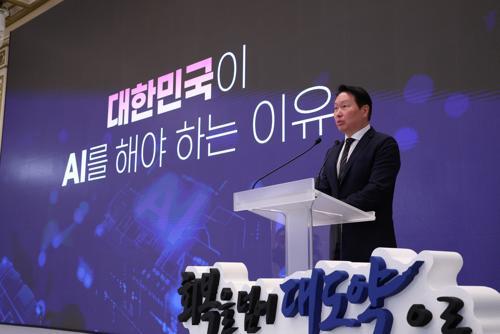
SK Group Chairman Chey Tae-won has unveiled ambitious investment plans totaling 2.100 trillion won (approximately $1.5 trillion USD) aimed at bolstering South Korea's artificial intelligence and semiconductor industries. The announcement, made at a government-industry briefing on major national projects, includes a 1.000 trillion won investment in AI data centers and another 1.100 trillion won dedicated to expanding the semiconductor supply chain.
AI can drastically reduce high societal costs and grow the national economy.
A key focus of the semiconductor investment is the establishment of a new production hub in the southwestern region, with an allocation of 400 trillion won. This initiative aims to create a second major semiconductor manufacturing base, building upon the existing cluster in Yongin. The move is strategically designed to meet the escalating global demand for semiconductors, particularly those essential for AI applications.
Chairman Chey emphasized the transformative potential of AI, stating it can "drastically reduce high societal costs and grow the national economy." He highlighted the need for "AI factories" – advanced AI data centers capable of producing intelligence – to facilitate AI export and build a domestic AI market. SK plans to construct 15GW of AI data center capacity across various regions, starting with 5GW in the first phase and expanding to 10GW in the second.
For this, we need intelligence production factories, that is, AI factories. That is, we need to build AI data centers quickly and on a large scale to export intelligence and build a domestic intelligence market.
The surge in AI data centers is expected to drive a proportional increase in demand for memory semiconductors. Chey drew an analogy to human memory, explaining that as AI capabilities grow, so does the need for data storage. To meet this demand, SK is accelerating its semiconductor production plans, bringing forward the completion of the Yongin cluster by 12 years and investing heavily in DRAM expansion in Yongin and Cheongju.
As a child grows older and gains more experience, their memory increases. Just as there is more memory to store, if AI's performance and usage continue to increase, the demand for memory semiconductors will also increase exponentially.
These substantial investments underscore SK Group's commitment to positioning South Korea as a global leader in AI and semiconductor technology. The company is carefully considering market demands, electricity supply, land availability, and water resources in its phased expansion plans, ensuring a strategic and sustainable approach to future growth.
SK's AI data centers can become South Korea's infrastructure.
DistantNews Editorial
Originally published by Dong-A Ilbo in Korean. Translated, summarized, and contextualized by our editorial team with added local perspective. Read our editorial standards.
More Stories


From Our Blog

What Gets Lost (and Found) When News Is Translated

The Critical Role of Diaspora Media in Global News

What Travellers Should Know About Countries with Restricted Press

A Digital Nomad's Guide to Following Local News

How the Same Story Looks Different in Different Countries
