


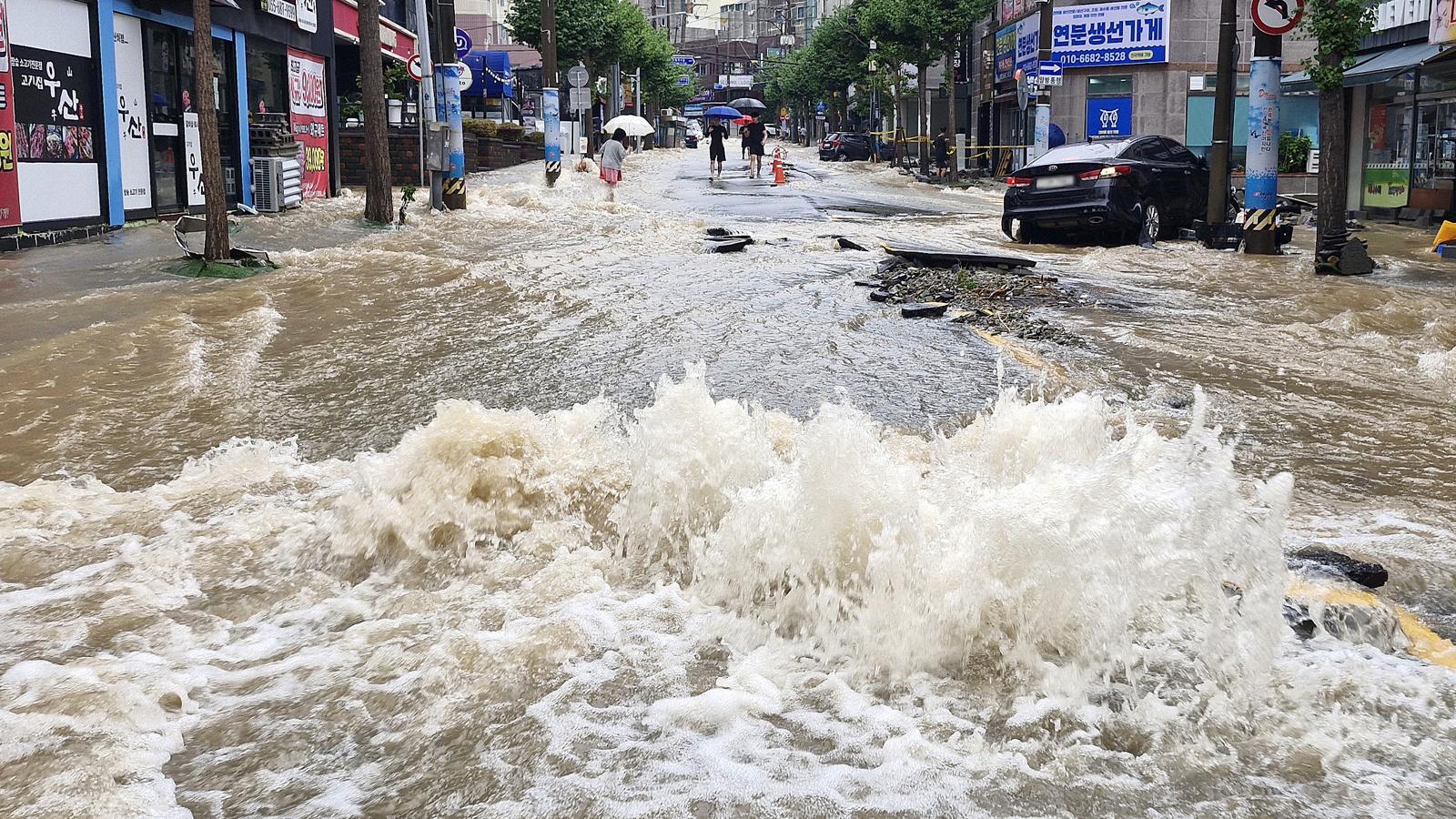
South Korea Faces 'Chain Complex Disasters' Amidst Extreme Weather
Translated from Korean, summarized and contextualized by DistantNews.
At a glance
News
Sources not specified
New plan
- South Korea experienced a series of extreme weather events including heatwaves, drought, and torrential rain in August 2026.
- Heavy rainfall in Geoje caused widespread flooding and resulted in five fatalities, setting a new record for hourly precipitation.
- Experts warn that climate change is increasing the frequency of complex, interconnected disasters, necessitating a new approach to disaster management.
South Korea is grappling with a "chain complex disaster" phenomenon, as extreme weather events like deadly heatwaves, sudden droughts, and monstrous downpours strike in rapid succession. In August 2026, the southern coastal region bore the brunt of this crisis. Geoje, in particular, was inundated by 916.1 mm of rain over the Liberation Day holiday weekend, with an hourly rainfall of 124.5 mm on August 17th, a record since weather observations began in 1972. This "monster rain," described as a once-in-200-years event, left five people dead and caused widespread flooding in nearby areas like Busan and Tongyeong.
The unusual weather pattern was attributed to a weakened Typhoon Dolphin being blocked by the North Pacific High, while a prolonged heatwave had increased the sea's moisture content. Typically, the North Pacific High recedes by mid-August, but its persistent presence this summer led to a relentless cycle of extreme heat, drought, and floods in the Yeongnam region.
This trend highlights a growing concern: climate change is intensifying extreme weather events and increasing the risk of multiple disasters occurring simultaneously. A study in the Korean Journal of Meteorology revealed that "heatwave-drought complex disasters" averaged 951.5 cases annually over the past decade, more than double the previous 45-year average. These complex disasters are more severe than single events, rendering historical climate averages increasingly irrelevant.
The current disaster management system in South Korea is ill-equipped to handle these interconnected threats. The "Framework Act on Disaster and Safety Management" categorizes events like heatwaves, droughts, and floods as separate natural disasters, failing to address simultaneous or sequential events. This fragmented approach leads to reactive measures, such as draining reservoirs for flood control only to face drought, or vice versa. Even the government's Central Disaster and Safety Countermeasures Headquarters operates independently for heatwaves and floods. To effectively prepare for extreme weather, South Korea must overhaul its disaster management framework to include chain complex disasters and build appropriate climate infrastructure.
DistantNews Editorial
Originally published by Dong-A Ilbo in Korean. Translated, summarized, and contextualized by our editorial team with added local perspective. Read our editorial standards.
More Stories


From Our Blog

What Gets Lost (and Found) When News Is Translated

The Critical Role of Diaspora Media in Global News

What Travellers Should Know About Countries with Restricted Press

A Digital Nomad's Guide to Following Local News

How the Same Story Looks Different in Different Countries
