

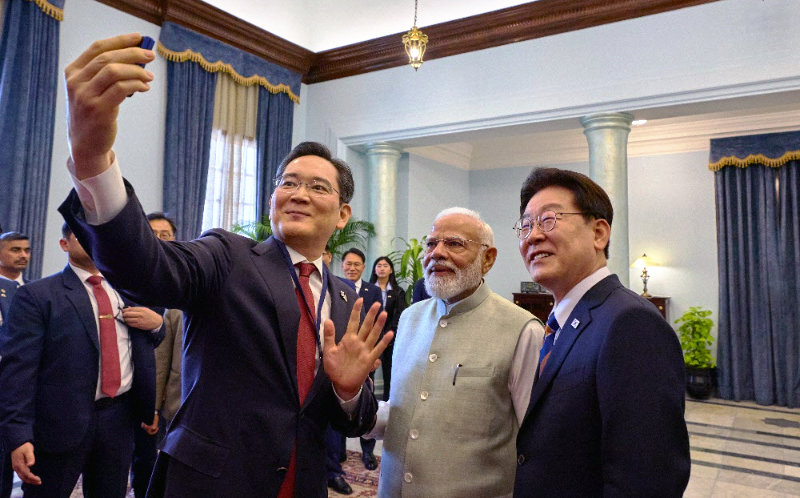

South Korea, India Eye 'Economic and Security Synergy,' Aim to Double Trade to $50 Billion in 4 Years
Translated from Korean, summarized and contextualized by DistantNews.
TLDR
- President Lee Jae-myung and Indian Prime Minister Narendra Modi agreed to expand economic cooperation and secure energy supply chains amidst global instability.
- The leaders committed to doubling bilateral trade to $50 billion by 2030 and establishing a new industrial cooperation committee.
- Key areas for enhanced collaboration include shipbuilding, finance, AI, defense, and cultural exchange.
Hankyoreh reports on a significant diplomatic and economic engagement between South Korea and India, highlighting President Lee Jae-myung's state visit to New Delhi. The summit with Prime Minister Narendra Modi resulted in a robust agreement to deepen bilateral ties, particularly in strategic sectors like shipbuilding, AI, and defense, alongside a commitment to boost trade significantly.
In an era of uncertainty, South Korea and India can become optimal all-around cooperation partners that promote mutual growth and innovation.
The article emphasizes the shared understanding between the two nations regarding the need for stable energy and raw material supply chains, a critical concern given the volatile geopolitical climate in the Middle East. The agreement to double trade to $50 billion by 2030 and establish a new industrial cooperation committee signals a strategic alignment aimed at mutual growth and resilience.
We have agreed to continue cooperation for the stable supply of energy resources and key raw materials, considering the recent situation in the Middle East.
From a South Korean perspective, this partnership is particularly noteworthy. India, with its vast market and growing economy, represents a crucial partner for South Korea's economic diversification and its efforts to secure vital resources. The focus on sectors like shipbuilding and defense aligns with South Korea's industrial strengths and strategic interests. The mention of Korean business leaders like Samsung's Lee Jae-yong and Hyundai's Chung Eui-sun attending the business forum underscores the high level of corporate interest and the potential for substantial private sector collaboration.
We have agreed to increase the bilateral trade volume, currently at about $26 billion annually, to $50 billion by 2030.
This summit is framed not just as an economic opportunity but also as a strategic move to enhance 'economic and security' cooperation. The establishment of a 'Korea Desk' within the Indian Prime Minister's office and a dedicated economic cooperation task force in the South Korean presidential office demonstrates a high-level commitment from both governments. The article implicitly suggests that this proactive engagement is essential for navigating global uncertainties, a perspective that resonates deeply in a region often facing complex security and economic challenges.
We have agreed to establish an industrial cooperation committee at the ministerial level to strengthen cooperation in strategic sectors such as key minerals, nuclear power, and clean energy, not only in trade and investment.
DistantNews Editorial
Originally published by Hankyoreh in Korean. Translated, summarized, and contextualized by our editorial team with added local perspective. Read our editorial standards.
More Stories


From Our Blog

What Gets Lost (and Found) When News Is Translated

The Critical Role of Diaspora Media in Global News

What Travellers Should Know About Countries with Restricted Press

A Digital Nomad's Guide to Following Local News

How the Same Story Looks Different in Different Countries
