


South Korea's apartment subscription competition rate hits 35-month low
Translated from Korean, summarized and contextualized by DistantNews.
At a glance
News
Documents & data
Context piece
- South Korea's average apartment subscription competition rate fell to 5.9:1 in June, the lowest in 35 months.
- This decline is attributed to rising interest rates, increased housing prices, and market uncertainty.
- The number of unsold homes remains high, with over 65,000 units recorded at the end of May.
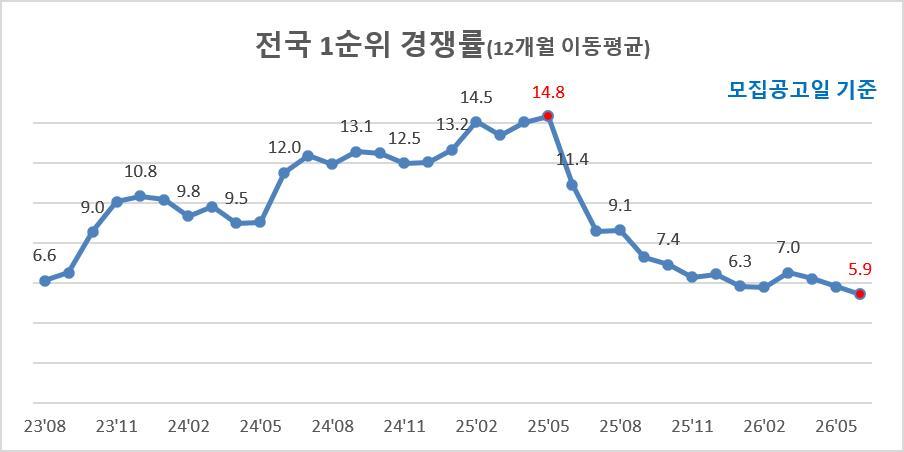
South Korea's apartment subscription market is rapidly cooling, with the average first-time subscriber competition rate dropping to 5.9:1 in June. This marks the lowest figure in approximately 35 months, signaling a significant downturn in buyer interest.
The competition rate has been on a downward trend since mid-2023. After peaking at 14.80:1 in May last year, it began to fall, consistently remaining in single digits since July. In June, the national average stood at 5.90:1, a decrease from 6.31:1 the previous month and less than half of the 11.41:1 recorded in June 2023.
Seoul experienced a particularly sharp decline, with its competition rate falling by 39.86 points to 113.14:1 in June, although it still maintained a three-digit figure. Regional markets also showed weakness, with Gyeongnam dropping to 4.88:1 and Chungnam to 2.95:1. Busan and Jeju saw slight decreases as well.
The recent increase in base interest rates, combined with uncertainty about future real estate policy changes, means that prospective subscribers are likely to continue observing the market.
This slump is reflected in individual apartment complexes, where 12 out of 27 complexes offered for subscription in June failed to fill their first-round vacancies. Some even saw competition rates below 0.1:1, indicating a severe contraction in demand. Even large-scale complexes with over 1,000 units struggled, with competition rates hovering around 1-2:1.
Analysts attribute the shrinking demand to a combination of factors, including the burden of high interest rates, rising apartment prices, and general market uncertainty. Experts predict a widening gap between competitive and less competitive new developments, with unsold inventory continuing to accumulate. As of the end of May, the number of unsold homes nationwide exceeded 65,000 units for 30 consecutive months, with Gyeonggi, Busan, Chungnam, and Gyeongnam provinces each having over 5,000 unsold units.
If demand becomes concentrated only on developments with proven location and product quality, new developments with lower competitiveness could further exacerbate the existing burden of unsold inventory.
DistantNews Editorial
Originally published by Dong-A Ilbo in Korean. Translated, summarized, and contextualized by our editorial team with added local perspective. Read our editorial standards.
More Stories


From Our Blog

What Gets Lost (and Found) When News Is Translated

The Critical Role of Diaspora Media in Global News

What Travellers Should Know About Countries with Restricted Press

A Digital Nomad's Guide to Following Local News

How the Same Story Looks Different in Different Countries
