


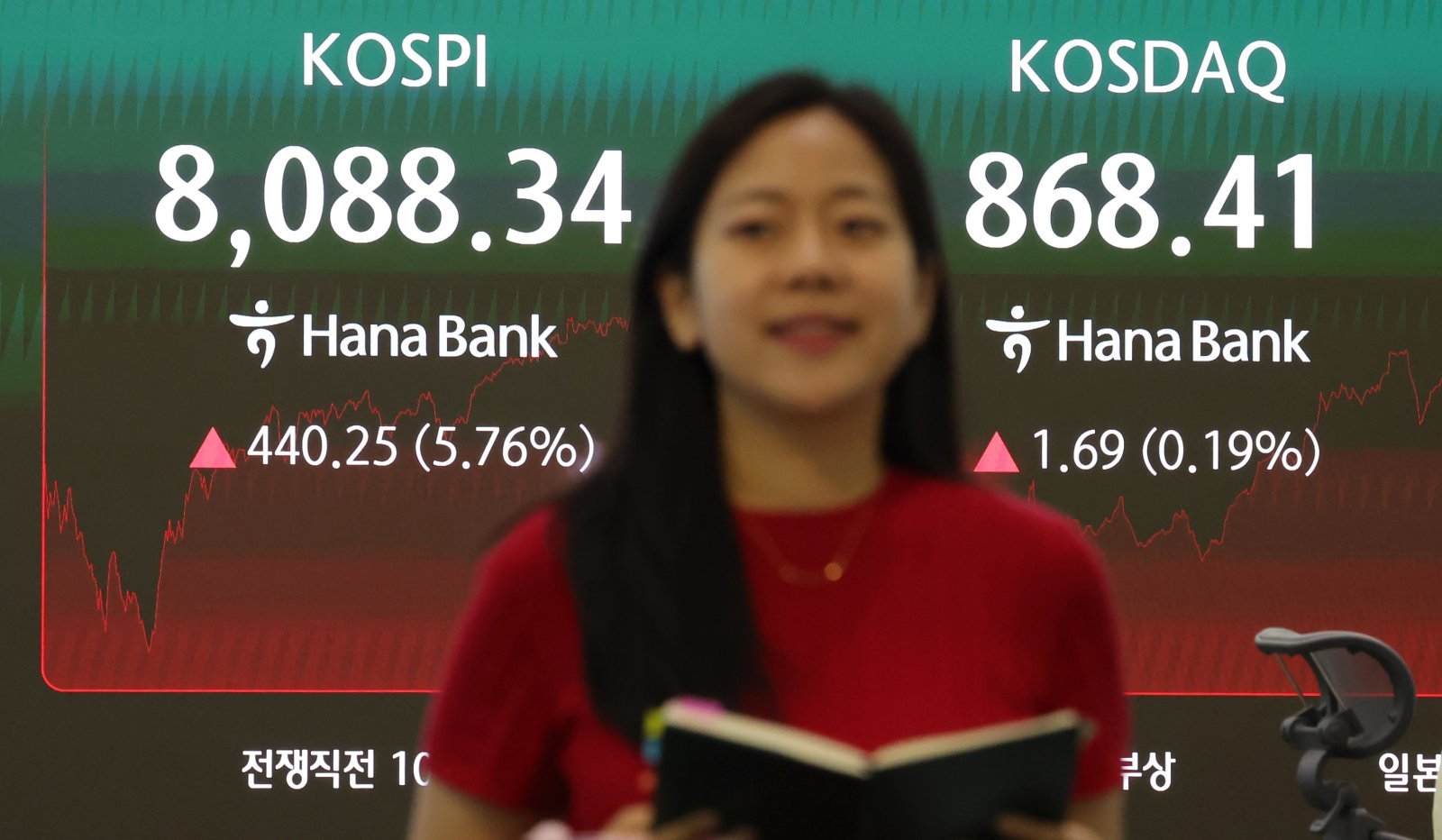
South Korea's 'Bitu' Jumps 4.2 Trillion Won in Q2 as KOSPI Surpasses 9,000
Translated from Korean, summarized and contextualized by DistantNews.
At a glance
News
Documents & data
New plan
- Individual investors' debt-funded investments, known as 'bitu,' increased by 4.2 trillion won in the second quarter.
- This rise occurred as the KOSPI index surpassed 9,000 points for the first time.
- While margin trading debt grew, securities-backed loans saw a slight decrease.
South Korean individual investors significantly increased their borrowing for stock investments in the second quarter, with debt-fueled trading, or 'bitu,' rising by 4.2 trillion won. This surge coincided with the KOSPI index reaching a historic milestone, breaking the 9,000-point mark for the first time.
Data from the Korea Financial Investment Association revealed that the outstanding balance for margin trading, a key indicator of investors' debt, stood at 37.3228 trillion won at the end of June. This represents a substantial 13.4% increase from the 32.9223 trillion won recorded at the end of the first quarter.
Margin trading involves investors borrowing money from brokerages to purchase stocks, with the outstanding amount reflecting their unpaid debt. While this form of borrowing expanded, the balance for securities-backed loans, where investors borrow funds using their stocks as collateral, saw a marginal decrease of 182.1 billion won, falling to 25.4948 trillion won from 25.6769 trillion won in the previous quarter.
Cumulatively, the total credit extended to investors, combining margin trading and securities-backed loans, reached 62.8176 trillion won. This marks a 7.2% increase, or 4.2184 trillion won, compared to the 58.5992 trillion won recorded at the close of the first quarter.
DistantNews Editorial
Originally published by Dong-A Ilbo in Korean. Translated, summarized, and contextualized by our editorial team with added local perspective. Read our editorial standards.
More Stories


From Our Blog

What Gets Lost (and Found) When News Is Translated

The Critical Role of Diaspora Media in Global News

What Travellers Should Know About Countries with Restricted Press

A Digital Nomad's Guide to Following Local News

How the Same Story Looks Different in Different Countries
