


South Korea’s Social-Studies Shift Deepens as Record 70% Choose the Subject for This Year’s College Exam
Translated from Korean and summarized by DistantNews. Read the original for the full story.
At a glance
News
Documents & data
New plan
- Social studies accounted for 69.6% of two-subject selections in the 2027 College Scholastic Ability Test, the highest share on record.
- The shift has been driven partly by science-track students choosing social studies after more universities began accepting those subjects for minimum score requirements in natural-science admissions.
- Analysts warned that the change could make grade predictions harder, widen subject-selection advantages and leave some science-track students with weaker basic science skills.
Seven out of 10 students choosing two subjects in the inquiry section of South Korea’s 2027 College Scholastic Ability Test selected social studies, marking the highest proportion on record.
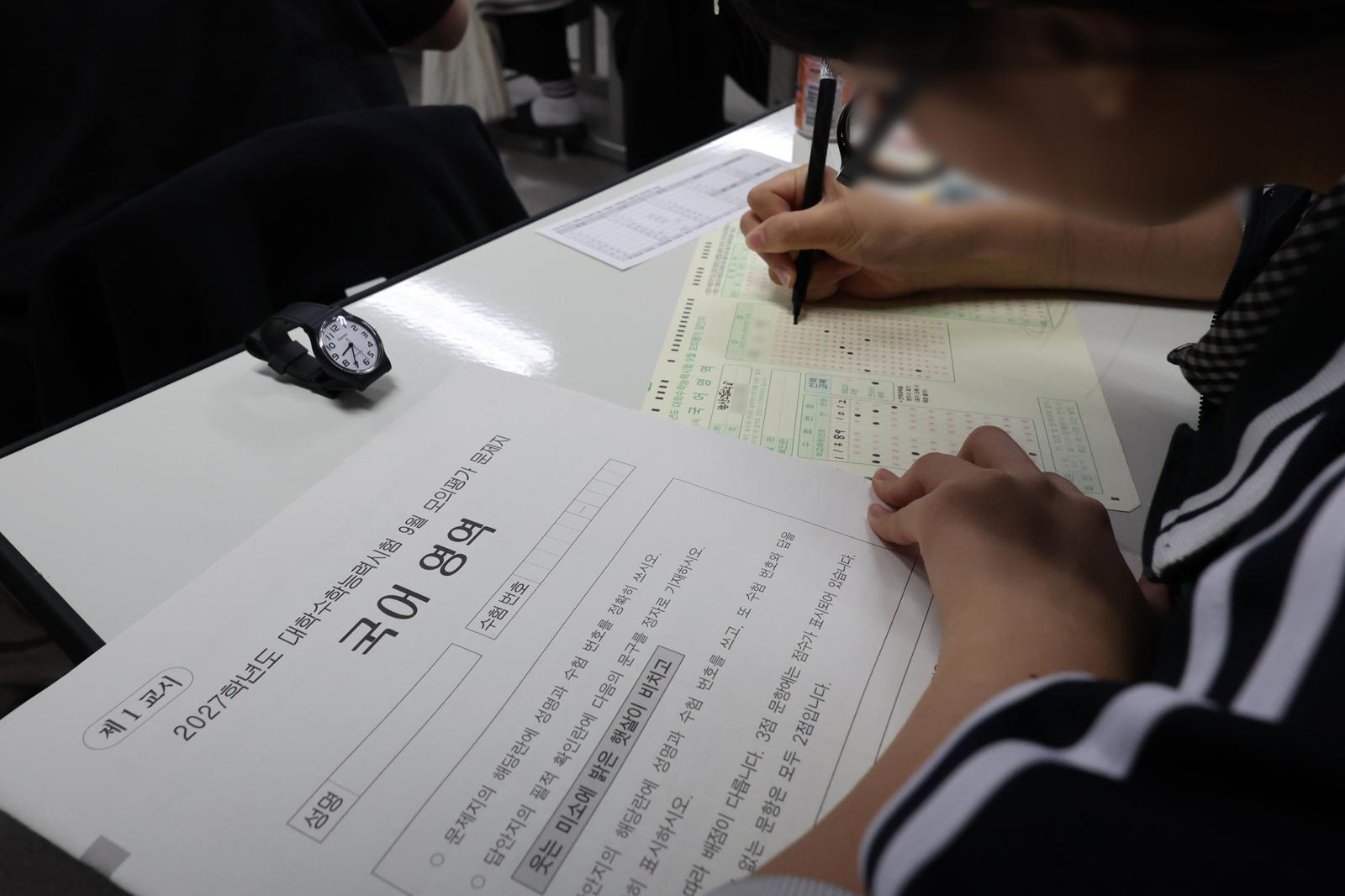
The Korea Institute for Curriculum and Evaluation said on the 8th that 551,864 students applied for the exam, which will be held on November 19. The total fell by 2,310 from last year. Current students accounted for 355,391 applicants, or 64.1%, down 4.4%, while graduates rose 8.6% to 173,706, or 31.5%.
The number of graduates was the highest in 23 years, according to the report. The increase was attributed to repeat test-takers from the 2007 birth cohort and university students retaking the exam before the current elective-subject system ends. Other applicants, including those with qualification exams, numbered 22,767, the second-highest figure in 32 years.
Among students selecting social or science studies, 69.6%, or 367,073 people, chose two social-studies subjects. The figure rose 8.6 percentage points from last year’s 61.0%. Those choosing two science subjects fell 8.5 points to 14.2%, while students choosing one subject from each group accounted for 16.1%, little changed from the previous year.
The standard-score advantage gained by taking social studies may not be as large as before as competition among social-studies examinees intensifies.
The trend, known as “social-studies flight,” has drawn science-track students toward social studies because more universities now accept those subjects when applying to natural-science programs. Students seeking to avoid the burden of science preparation have moved to social studies, while others have followed because they fear the decline in science examinees will make it harder to secure desired grades.
Analysts said the shift could make it harder to predict grades and increase the impact of subject choice for both humanities and science-track applicants. Students entering science programs after taking social studies could also face difficulties because of weaker basic science knowledge.
A similar move toward probability and statistics continued in mathematics. The subject’s share rose 7.8 percentage points to 64.9%, while calculus fell 7.5 points to 32.4%. Education researcher Lee Man-ki said competition among social-studies students could reduce the former standard-score advantage of choosing the subject, while science-subject bonuses and the highest standard scores for calculus and geometry could become more valuable.
An online pre-entry system introduced nationwide this year was used by 93.9% of applicants. Usage reached 99.1% among current students, compared with 84.6% among graduates and other applicants.
The value of bonus points for science subjects in university admissions could instead become greater than before.
About this summary
Originally published by Hankyoreh in Korean. Translated, summarized, and contextualized automatically by DistantNews, with a note on how the source frames the story. Not individually reviewed before publishing. How this works.
More Stories


From Our Blog

News in Translation: What Gets Lost, and How We Keep the Framing

Diaspora Media: How Communities Follow News From Home

Traveling Where the Press Is Not Free: How to Read the News There

The Digital Nomad's Guide to Local News

The Same Story, Different Countries: How Coverage Changes at the Border
