


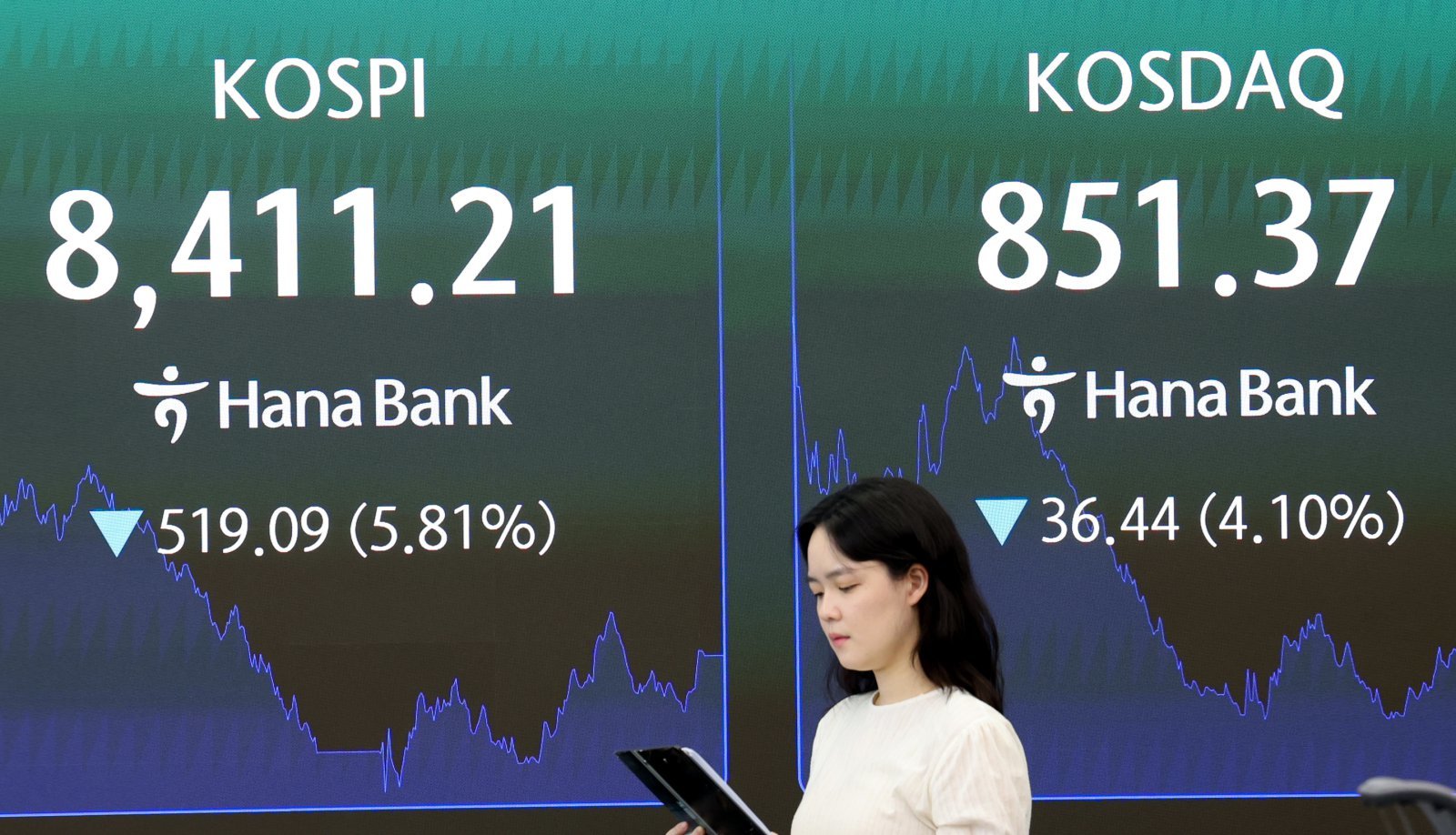
South Korea's stock market swings wildly, daily fluctuations near 4%
Translated from Korean, summarized and contextualized by DistantNews.
At a glance
News
Sources not specified
Context piece
- South Korea's stock market is experiencing extreme volatility, with daily index fluctuations averaging nearly 4%.
- This volatility is driven by a heavy concentration in semiconductor stocks and increased trading of leveraged ETFs, amplifying market swings.
- The market has seen unprecedented trading halts, with circuit breakers triggered twice in one week, signaling a period of heightened risk.
Seoul's stock market is caught in a turbulent cycle of extreme volatility, with daily index swings averaging a staggering 3.88%. This unpredictable trading environment has become the norm, instilling fear and panic among market participants. The situation escalated dramatically last week, with trading halts occurring twice, marking the most volatile week in the history of the KOSPI index.
The essence of yesterday's decline is not a new major negative factor, but a unwinding of concentrated semiconductor positions.
The market's sharp movements, both up and down, are largely attributed to the heavy concentration of the KOSPI's total market capitalization in semiconductor stocks. Fluctuations in major semiconductor companies like Samsung Electronics and SK Hynix now disproportionately impact the entire index, amplifying market uncertainty with even minor industry news.
Adding to the instability is the surge in trading of leveraged and inverse exchange-traded funds (ETFs). These products require frequent rebalancing to maintain their target leverage ratios. As individual stock volatility increases, the mechanical trading volume of these ETFs grows, further exacerbating supply and demand imbalances in the market.
The combination of single-stock leveraged ETFs and passive ETF flows concentrated in top market-cap stocks amplifies selling pressure with even small noises.
Experts anticipate this volatility may intensify. "The essence of yesterday's decline is not a new major negative factor, but a unwinding of concentrated semiconductor positions," noted Lee Jae-won, a researcher at Yuanta Securities. He added that "the combination of single-stock leveraged ETFs and passive ETF flows concentrated in top market-cap stocks amplifies selling pressure with even small noises." Lee predicts that as long as this trend of concentrated retail investor demand in large-cap stocks and leveraged ETFs continues, sharp price swings will persist.
As long as this trend of concentrated retail investor demand in large-cap stocks and leveraged ETFs continues, sharp price swings will persist.
DistantNews Editorial
Originally published by Dong-A Ilbo in Korean. Translated, summarized, and contextualized by our editorial team with added local perspective. Read our editorial standards.
More Stories



From Our Blog

What Gets Lost (and Found) When News Is Translated

The Critical Role of Diaspora Media in Global News

What Travellers Should Know About Countries with Restricted Press

A Digital Nomad's Guide to Following Local News

How the Same Story Looks Different in Different Countries
