


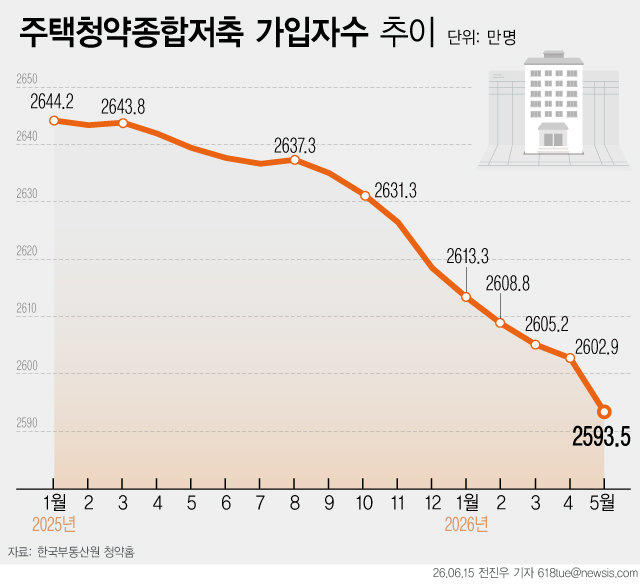
South Korea sees housing subscription accounts drop below 26 million amid 'cheongpojok' surge
Translated from Korean, summarized and contextualized by DistantNews.
At a glance
News
Documents & data
Context piece
- The number of "subscription-renouncing people" (cheongpojok) in South Korea has surged, causing the total number of housing subscription account holders to fall below 26 million.
- This decline is attributed to rising housing prices and intensified competition for prime locations.
- The number of first-time applicants also decreased significantly, indicating a broader trend of disengagement from the housing subscription system.
South Korea is witnessing a significant drop in housing subscription account holders, falling below the 26 million mark for the first time in recent years. This decline is largely driven by a growing segment of the population, dubbed 'cheongpojok' or 'subscription-renouncing people,' who are giving up on the prospect of homeownership through the subscription system.
Data from the Korea Real Estate Board's 'Cheongyak Home' shows that as of the end of last month, the total number of subscription accounts stood at 25,934,673. This represents a decrease of 94,826 accounts in just one month. Compared to the same period last year, the number has fallen by over 450,000, highlighting an accelerating trend.
Analysts attribute this phenomenon to soaring housing prices and fierce competition for desirable properties. The dream of owning a home through the subscription system is becoming increasingly elusive for many, particularly younger generations. The number of first-time applicants has also seen a substantial decrease, both month-on-month and year-on-year, further underscoring the growing disillusionment with the system. While second-time applicants saw a slight increase compared to last year, the overall trend points to a weakening engagement with housing subscriptions.
DistantNews Editorial
Originally published by Dong-A Ilbo in Korean. Translated, summarized, and contextualized by our editorial team with added local perspective. Read our editorial standards.
More Stories



From Our Blog

What Gets Lost (and Found) When News Is Translated

The Critical Role of Diaspora Media in Global News

What Travellers Should Know About Countries with Restricted Press

A Digital Nomad's Guide to Following Local News

How the Same Story Looks Different in Different Countries
