


South Korea to Cut Industrial Electricity Rates by Up to 10% in Some Regions
Translated from Korean, summarized and contextualized by DistantNews.
At a glance
News
Named sources
New plan
- South Korea plans to introduce a regional electricity pricing system for industrial use, aiming to reduce corporate costs and encourage regional investment.
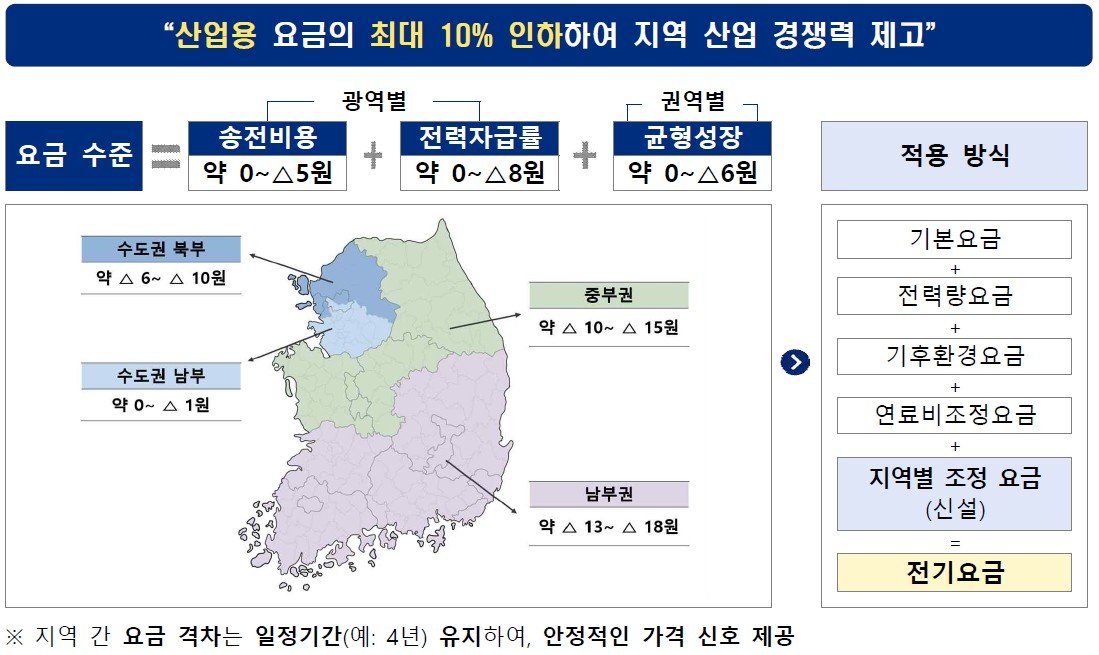
- The new system will differentiate electricity rates based on regional supply and demand, with areas like Yeongnam and Honam potentially seeing up to a 10% reduction.
- The government expects the reform to decrease the electricity cost burden for industries by approximately 2.8 trillion won annually and promote balanced national development.
South Korea is set to implement a regional electricity pricing system for industrial users, a move designed to alleviate the financial burden on businesses and stimulate investment outside the Seoul metropolitan area. The Ministry of Climate, Energy and Environment and Korea Electric Power Corporation (KEPCO) unveiled the draft plan, which differentiates electricity rates based on local power supply and demand dynamics. Under the proposed system, regions with abundant electricity generation, such as Yeongnam and Honam in the south, could see their industrial electricity costs decrease by up to 10%, or approximately 13 to 18 won per kilowatt-hour (kWh), compared to the current average industrial rate of 181.9 won/kWh. Conversely, areas with higher demand and less local generation, like southern Seoul and Gyeonggi Province, will experience minimal reductions, possibly as little as 0 to 1 won per kWh. The government aims to encourage companies to invest in regions with surplus power, thereby reducing the need for extensive transmission infrastructure and mitigating associated conflicts. This initiative is rooted in the "Special Act on Distributed Energy," and the government anticipates it will reduce the overall electricity cost burden for industries by about 2.8 trillion won annually. Officials believe this policy will not only help rebalance power demand across the country but also enhance the competitiveness of domestic industries, particularly traditional manufacturing firms in regional areas. The plan also seeks to support the growth of advanced industries in the provinces, fostering job creation and economic revitalization. KEPCO plans to minimize its financial impact through measures like introducing a locational marginal pricing (LMP) system and seeking government financial support. The government is aiming to finalize and implement the system within the year.
The introduction of the regional electricity pricing system for industrial use, following the time-based electricity rate reform in April, is key to reforming the electricity rate system for the mutual growth of KEPCO and industry.
DistantNews Editorial
Originally published by Dong-A Ilbo in Korean. Translated, summarized, and contextualized by our editorial team with added local perspective. Read our editorial standards.
More Stories


From Our Blog

What Gets Lost (and Found) When News Is Translated

The Critical Role of Diaspora Media in Global News

What Travellers Should Know About Countries with Restricted Press

A Digital Nomad's Guide to Following Local News

How the Same Story Looks Different in Different Countries
