


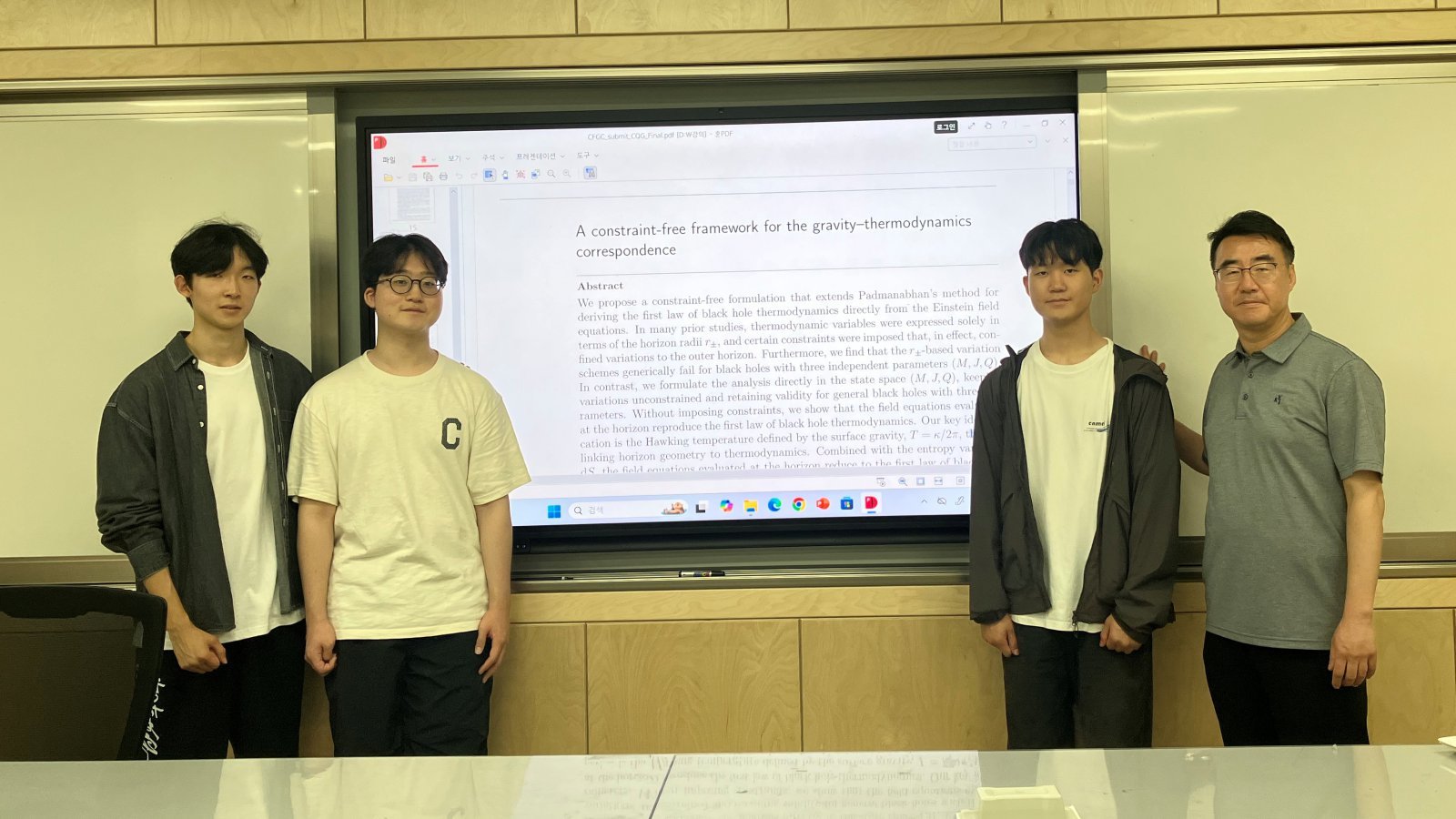
South Korean High School Students' Paper on Black Hole Secrets Published in International Journal
Translated from Korean, summarized and contextualized by DistantNews.
At a glance
News
Named sources
Approved/passed
- Three South Korean high school students and their physics teacher have had a paper on black hole thermodynamics published in an international academic journal.
- Their research, titled 'Unrestricted Black Hole Thermodynamics Formulation Derived from the Jang Equation,' offers a new approach to understanding black hole behavior.
- The paper successfully proved that the laws of thermodynamics apply to black holes, even in complex scenarios like rotating or charged black holes, and in hypothetical higher dimensions.
A groundbreaking paper authored by three high school students from Seoul Science High School, along with their physics teacher, has achieved a significant milestone with its publication in the prestigious 'International Journal of Modern Physics D.' The research, titled 'Unrestricted Black Hole Thermodynamics Formulation Derived from the Jang Equation,' presents a novel approach to understanding the thermodynamic properties of black holes.
It is particularly impressive that such a sophisticated and high-level study was carried out by high school students.
The study addresses a long-standing challenge in physics: demonstrating that black holes adhere to the first law of thermodynamics. While previous research used mathematical methods like the 'field equations' to derive this, it primarily focused on the change in the size of a black hole's outer surface. This limitation made it difficult to apply the findings to more complex black holes, such as those that are rotating or possess an electric charge.
The team, comprising students Bae Ijin, Ahn Geon-woo, and Jang Geun-young, along with their teacher Kwon Yong-jun, overcame this hurdle by introducing entropy, a measure of disorder, into the Jang equation. Unlike previous methods that focused on surface area, their approach incorporates information from both the inner and outer surfaces of a black hole. This innovative method allowed them to prove, for the first time, that the thermodynamic laws hold true even for irregularly shaped black holes and in hypothetical universes with higher dimensions.
The students' intellectual curiosity and passion, supported by the school, have borne excellent fruit.
Significantly, this advanced research was conducted entirely within the school's educational system, without external institutional support. Reviewers lauded the work, noting their "particular impression" that such a sophisticated study was carried out by high school students. Teacher Kwon Yong-jun expressed pride in the students' intellectual curiosity and the school's supportive environment, emphasizing the joy of mutual growth between teacher and student. The students themselves described the process as challenging yet exciting, expressing deep gratitude for their teacher's guidance.
Overcoming the limitations of previous research and adding new interpretations was challenging and very interesting.
DistantNews Editorial
Originally published by Dong-A Ilbo in Korean. Translated, summarized, and contextualized by our editorial team with added local perspective. Read our editorial standards.
More Stories



From Our Blog

What Gets Lost (and Found) When News Is Translated

The Critical Role of Diaspora Media in Global News

What Travellers Should Know About Countries with Restricted Press

A Digital Nomad's Guide to Following Local News

How the Same Story Looks Different in Different Countries
