


South Korean household surplus grows, but real wages fall sharply
Translated from Korean and summarized by DistantNews. Read the original for the full story.
At a glance
News
Official statement
Outcome reported
- South Korea's household surplus increased by 9.6% year-on-year in the second quarter as income outpaced spending.
- Real labor income fell by 2.1%, the largest drop in six years, due to a weak job market.
- Government support payments significantly boosted overall income, while real consumption growth remained sluggish.
South Korea's household surplus grew by 9.6% in the second quarter compared to the previous year, as income rose faster than expenditures. However, this growth was largely driven by government support, with real labor income experiencing its most significant decline in six years.
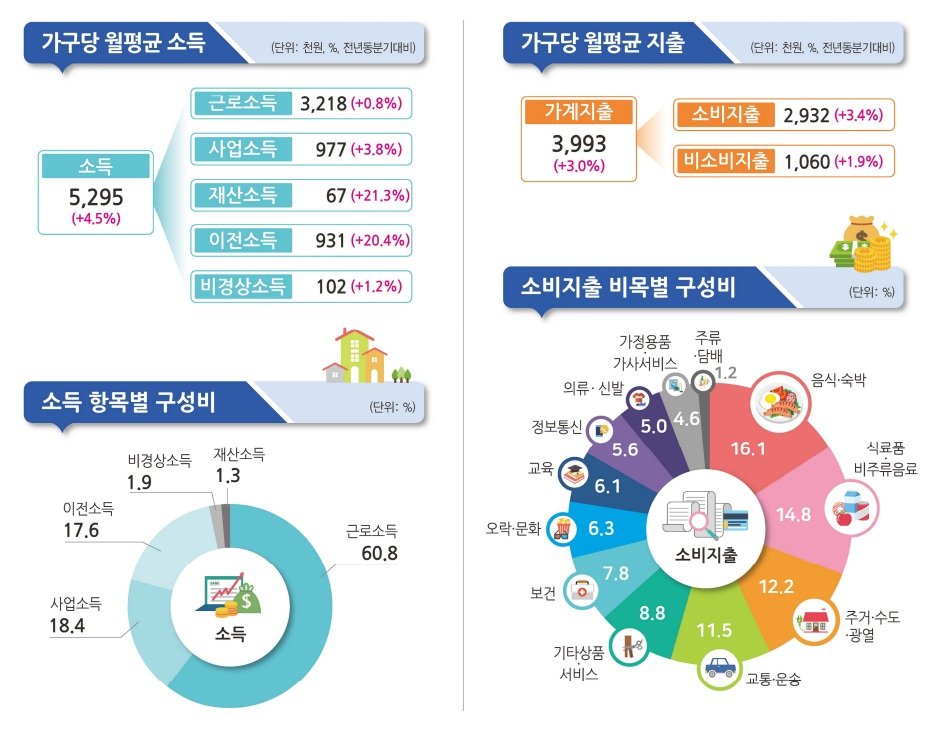
Real household income, excluding inflation, increased by 1.5% year-on-year. This marks a rebound from the first quarter's 0.4% growth. Despite this, nominal average monthly labor income saw only a modest 0.8% increase, reaching 3.218 million won. Crucially, real labor income, adjusted for inflation, decreased by 2.1%, continuing a downward trend for the second consecutive quarter.
The sharpest decline in real labor income in nine quarters, and the largest for a second quarter since 2020, was attributed to a slowdown in wage growth and a shift from employment growth to a decline in the number of wage workers. Meanwhile, nominal average monthly income rose by 4.5% to 5.295 million won, primarily due to a 20.4% surge in transfer income, which includes government subsidies and aid. This transfer income accounted for approximately 70% of the total income increase.
Consumption showed a weak recovery, with real spending increasing by only 0.4%. Government support payments, such as those for high oil prices, disproportionately benefited lower-income households, leading to an improvement in income distribution. The income gap between the richest and poorest households narrowed to its lowest point since 2006.
The number of wage workers slowed in the first quarter and turned to a decrease in the second quarter, and wage growth also slowed.
About this summary
Originally published by Dong-A Ilbo in Korean. Translated, summarized, and contextualized automatically by DistantNews, with a note on how the source frames the story. Not individually reviewed before publishing. How this works.
More Stories


From Our Blog

What Gets Lost (and Found) When News Is Translated

The Critical Role of Diaspora Media in Global News

What Travellers Should Know About Countries with Restricted Press

A Digital Nomad's Guide to Following Local News

How the Same Story Looks Different in Different Countries
