


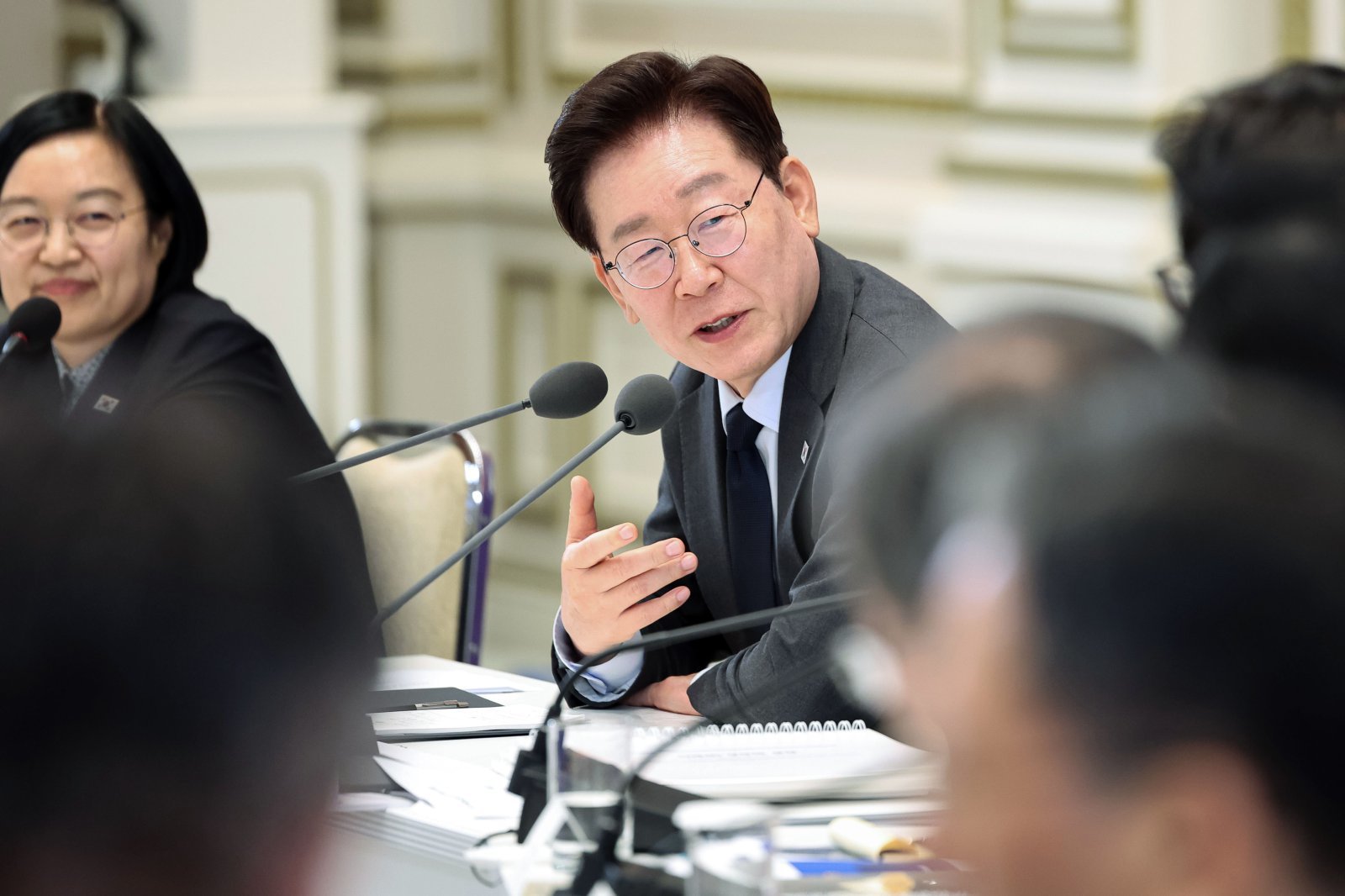
South Korean President Proposes Adjusting Household Electricity Rates
Translated from Korean, summarized and contextualized by DistantNews.
At a glance
News
Sources not specified
New plan
- South Korean President Lee Jae-myung suggested adjusting household electricity rates if it doesn't burden consumers, proposing a tiered pricing system.
- He questioned the current uniform electricity pricing and asked about plans for a "flexible pricing system" that charges less during off-peak hours.
- The president also proposed increasing the budget for electricity vouchers for low-income households, deeming the current amount insufficient.
South Korean President Lee Jae-myung indicated that household electricity rates should be adjusted if it does not increase the burden on consumers, suggesting a need to reform the current system that applies the same rates regardless of the time of day.
During a national fiscal strategy meeting held at the Blue House on July 13, 2026, President Lee inquired about the progress of a "flexible pricing system." He asked if the Ministry of Climate, Energy, and Environment was preparing a system where electricity is cheaper during off-peak hours and more expensive during peak times. Minister of Climate Kim Sung-hwan confirmed that industrial electricity rates were changed to a time-based system earlier in the year but household rates remained unchanged.
If there is no burden on prices or people's income, then household electricity rates should be adjusted.
When President Lee asked if household rates would eventually expand to this system, Minister Kim replied affirmatively, stating that plans exist to expand it nationwide, starting with Jeju Island. Kim also noted the global trend where industrial electricity rates are typically lower than household rates, citing that businesses need to remain competitive internationally. He provided figures showing South Korea's industrial electricity rate at 180 won per kilowatt (KW), compared to China's 120 won, while household rates in South Korea hover around 150-160 won per KW.
The suspect, initial MY, residing around the school's location, has been secured.
President Lee then remarked, "If there is no burden on prices or people's income, then household electricity rates should be adjusted." He acknowledged that raising rates could disproportionately affect low-income households and proposed supporting them through a voucher system, either financially or through the rate structure itself. Since the rate system cannot distinguish between high and low-income earners, he concluded that introducing a voucher system would be the most practical solution.
Minister Kim agreed with the proposal. President Lee inquired about the annual budget for electricity vouchers, and Minister Kim estimated it to be between 800 billion and 1 trillion won. President Lee found this amount to be "too small" and suggested further policy discussions would be necessary.
Too small.
DistantNews Editorial
Originally published by Dong-A Ilbo in Korean. Translated, summarized, and contextualized by our editorial team with added local perspective. Read our editorial standards.
More Stories


From Our Blog

What Gets Lost (and Found) When News Is Translated

The Critical Role of Diaspora Media in Global News

What Travellers Should Know About Countries with Restricted Press

A Digital Nomad's Guide to Following Local News

How the Same Story Looks Different in Different Countries
