


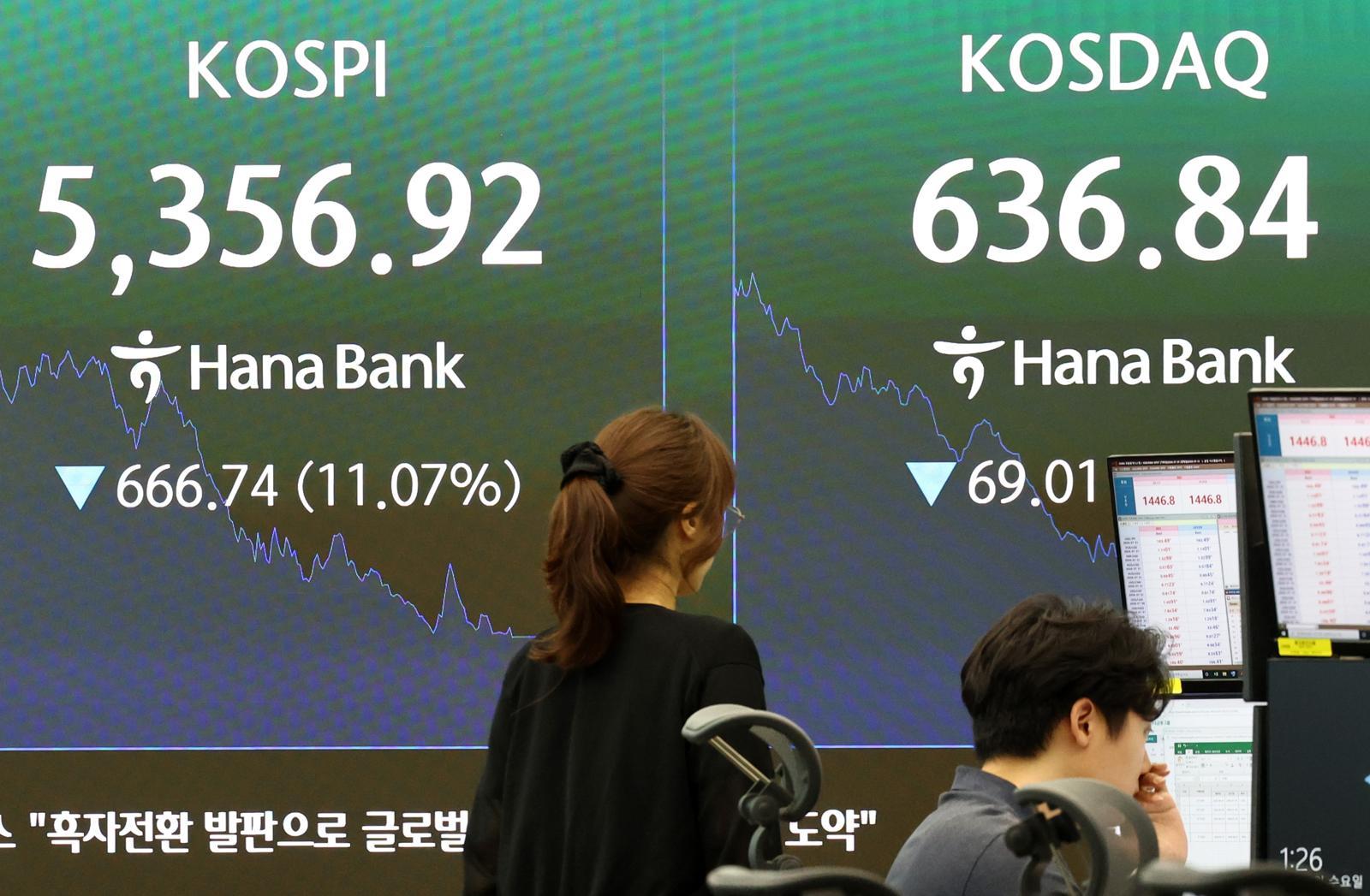
South Korean Stocks Plunge, Triggering Circuit Breakers for Second Consecutive Day
Translated from Korean, summarized and contextualized by DistantNews.
At a glance
News
Named sources
Context piece
- The South Korean stock market, KOSPI, closed down 5.99% at 5663.08 points on July 29th, marking its second consecutive day of trading halts.
- KOSPI experienced a sharp intraday drop of 12.63% to 5262.77, falling below the 5300 mark at one point.
- This marks the first time in the system's history that circuit breakers were triggered on both KOSPI and KOSDAQ for two consecutive trading days.
South Korea's stock market experienced a dramatic downturn on July 29th, with the KOSPI index closing down 5.99% at 5663.08 points. This followed a significant drop the previous day, and for the second consecutive trading session, both the KOSPI and KOSDAQ markets triggered circuit breakers, halting trading temporarily. This marks an unprecedented event since the implementation of the circuit breaker system.
During intraday trading, the KOSPI plummeted by over 12% to 5262.77, briefly dipping below the 5300 level. Major technology stocks were hit hard, with SK Hynix falling over 18% at one point and Samsung Electronics dropping 13%. SK Hynix and Samsung Electronics ultimately closed down 9.61% and 5.23% respectively.
The consecutive trading halts are attributed to a combination of factors. Overnight, the New York stock market saw declines in semiconductor stocks due to concerns about the sustainability of investment in the sector, controversies surrounding Nvidia's 'circular finance' trading, and the growing influence of China's semiconductor industry. The Philadelphia Semiconductor Index, a key benchmark, fell 4.5% over four consecutive days.
Furthermore, the recent IPO of China's Changxin Memory Technologies (CXMT) has intensified fears of China rapidly catching up to South Korea's memory chip industry. CXMT's successful listing, which surpassed Intel's market capitalization on its debut and raised significant capital, coupled with reports of China's progress in mass-producing deep ultraviolet (DUV) lithography equipment, has fueled anxieties about China's accelerating technological self-reliance.
DistantNews Editorial
Originally published by Dong-A Ilbo in Korean. Translated, summarized, and contextualized by our editorial team with added local perspective. Read our editorial standards.
More Stories


From Our Blog

What Gets Lost (and Found) When News Is Translated

The Critical Role of Diaspora Media in Global News

What Travellers Should Know About Countries with Restricted Press

A Digital Nomad's Guide to Following Local News

How the Same Story Looks Different in Different Countries
