


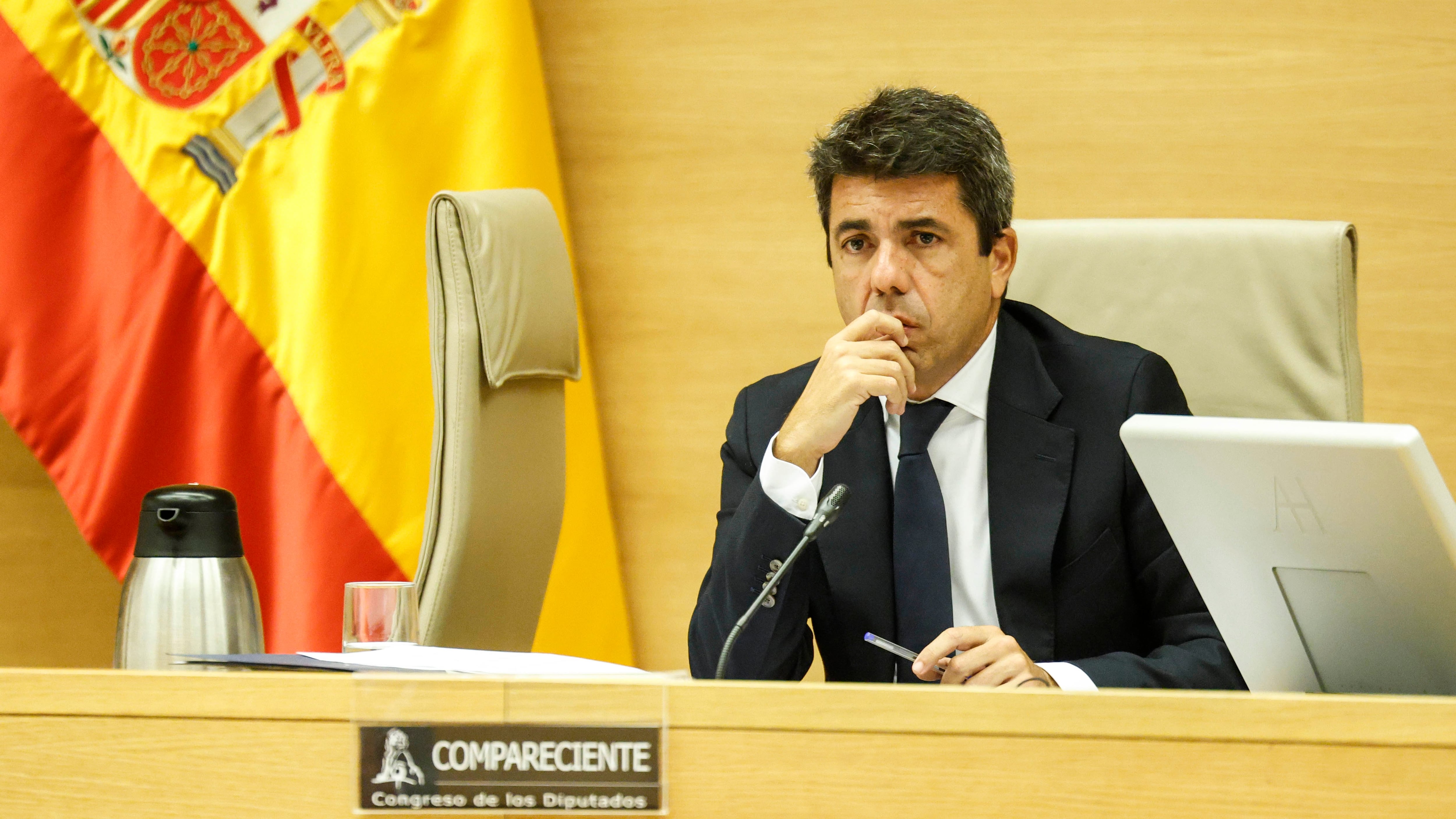
Spanish parties demand former Valencian leaders return to storm investigation committee
Translated from Spanish, summarized and contextualized by DistantNews.
At a glance
News
Named sources
Context piece
- Compromís and Izquierda Unida are demanding the return of former Valencian president Carlos Mazón and ex-minister Salomé Pradas to a congressional investigation committee.
- The demand follows the release of WhatsApp messages exchanged by the Valencian government during a severe storm (dana), which the parties argue contradict official narratives.
- They accuse Mazón of instructing his team to
Compromís and Izquierda Unida are calling for the re-appearance of former Valencian president Carlos Mazón and ex-minister Salomé Pradas before a congressional committee investigating the severe storm (dana). The demand stems from the recent disclosure of WhatsApp messages exchanged within the Valencian government during the event, messages that the parties claim reveal a starkly different reality than what has been officially presented.
Mazón wrote a single instruction shortly before nine in the morning: 'flood' the media with information. It's sadistic to use that verb. Then he disappeared and didn't write to his ministers again all day.
Compromís deputy Alberto Ibáñez highlighted Mazón's alleged instruction to "flood" the media with information shortly before the storm, a verb he described as "sadistic." Ibáñez noted that Mazón then "disappeared" and ceased communication with his ministers for the remainder of the day. He also pointed to messages from Salomé Pradas, the then-regional minister of Justice and Interior, indicating that by midday, the government was aware the emergency extended beyond the Magro River to the Poyo ravine, directly refuting claims of an information blackout or lack of cooperation from the Júcar Hydrographic Confederation.
Mazón had previously insisted that official government agencies provided insufficient information and that decisions were made based on the data available. He also cited an "information blackout" regarding the Poyo ravine, blaming the Júcar Hydrographic Confederation for withholding crucial details. This narrative, which the investigating judge has reportedly dismantled in numerous rulings, suggests that the regional government's response was hampered by a lack of timely information from central government bodies like the Júcar Confederation and the State Meteorological Agency (Aemet).
The relevant thing is that at one in the afternoon, ex-minister Salomé Pradas communicated to the rest of the Government that the emergency was not limited to the Magro River, but also affected the Poyo ravine; therefore, they knew what was happening.
However, the leaked messages suggest a different sequence of events. They indicate that Mazón, before a regional government council meeting to discuss the catastrophe (which Aemet had warned about eight days prior), instructed Pradas to update information for a press conference. He also told then-minister José Antonio Rovira to do the same regarding school closures. The article notes that the minister of Science and PSPV secretary-general, Diana Morant, described the private conversations of the Consell members as "harsh," stating, "They all lied to us."
We all lied to us.
DistantNews Editorial
Originally published by El País in Spanish. Translated, summarized, and contextualized by our editorial team with added local perspective. Read our editorial standards.
More Stories
From Our Blog

What Gets Lost (and Found) When News Is Translated

The Critical Role of Diaspora Media in Global News

What Travellers Should Know About Countries with Restricted Press

A Digital Nomad's Guide to Following Local News

How the Same Story Looks Different in Different Countries
