

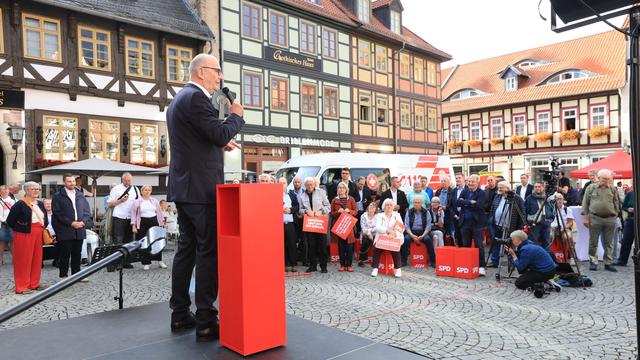

SPD Politicians Reject Calls to End Firewall With AfD
Translated from German and summarized by DistantNews. Read the original for the full story.
At a glance
News
Named sources
Context piece
- Several SPD politicians rejected former SPD politician Torsten Albig's proposal to end the "firewall" policy with the AfD.
- Politicians stated there can be no cooperation with the AfD, citing its ideology and historical context.
- Albig, now a lobbyist for a tobacco company, suggested SPD should consider minority governments tolerated by the AfD.
Proposals by former SPD politician Torsten Albig to dismantle the political "firewall" against the AfD have met strong opposition from within the Social Democratic Party (SPD). Multiple SPD leaders have spoken out against Albig's calls for cooperation with the Alternative for Germany (AfD) party.
Jochen Ott, SPD parliamentary group leader and lead candidate in North Rhine-Westphalia, stated, "For social democrats, there can never be cooperation with the ideological descendants of a party that persecuted us. The enemy is on the right." Similarly, Julian Barlen, SPD parliamentary group leader in Mecklenburg-Vorpommern, criticized Albig, suggesting that his current role as a lobbyist for tobacco giant Philip Morris indicates a willingness to promote "toxic ideas."
Albig had pointed to Mecklenburg-Vorpommern, where the AfD is leading in polls ahead of the September state election, as an example for potential cooperation. However, Stefan Krach, the SPD leader in Berlin and lead candidate for the upcoming election there, asserted that the AfD fundamentally contradicts the SPD's values. He described the AfD as largely far-right, serving only the wealthy, opposing women's and workers' rights, aiming to destroy democracy, and aligning with Russian President Putin.
Albig, who previously served as Minister-President of Schleswig-Holstein, had advised Chancellor Friedrich Merz (CDU) and SPD leader Lars Klingbeil to prepare for minority governments in the states. He argued that if 30 percent of the electorate supports the AfD, the SPD cannot continue to act as if the party is "the spawn of hell." Albig suggested that after the Mecklenburg-Vorpommern election, Minister-President Manuela Schwesig could seek parliamentary majorities on an issue-by-issue basis. Albig, who left active politics in 2017, transitioned to the business sector, eventually becoming a lobbyist for Philip Morris three years ago.
About this summary
Originally published by Die Zeit in German. Translated, summarized, and contextualized automatically by DistantNews, with a note on how the source frames the story. Not individually reviewed before publishing. How this works.
More Stories

From Our Blog

News in Translation: What Gets Lost, and How We Keep the Framing

The Same Story, Different Countries: How Coverage Changes at the Border

Diaspora Media: How Communities Abroad Follow Home

Traveling Where the Press Is Not Free: How to Read the News There

The Digital Nomad's Guide to Local News
