


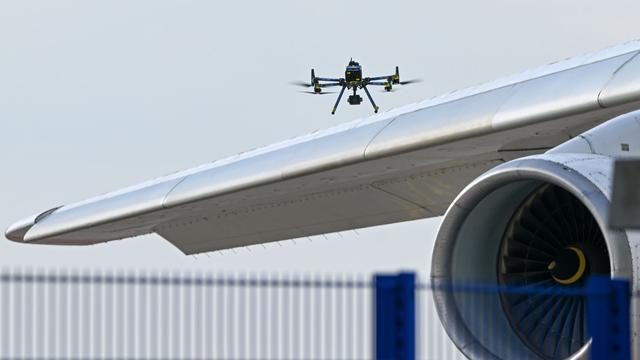
Study: Europe not well-prepared for drone attacks
Translated from German, summarized and contextualized by DistantNews.
At a glance
News
Documents & data
Context piece
- A new study indicates that Europe is inadequately prepared for drone attacks.
- European nations struggle to definitively attribute drone attacks to Russia.
- The study criticizes Europe's fragmented anti-drone architecture and nationalistic approaches.
Europe's defenses against drone attacks are insufficient, according to a new international study that raises alarms about the continent's readiness to counter threats from Russia.
The research, conducted by the London-based International Institute for Strategic Studies (IISS) with participation from the Hanns-Seidel-Stiftung, found that European states are currently unable to definitively attribute drone attacks to Russia. This lack of attribution capability hinders effective response strategies, despite the "very likely" scenario that Russia has initiated a campaign against Europe.
The study's authors state, "Our essential judgment is that Europe's current anti-drone architecture is not yet up to the level of the threat, although NATO, the EU, and national governments are now paying more attention to the issue." They highlight that authorities are divided, and the available options for responding to attacks are inadequate. A significant criticism is the overly nationalistic approach taken by individual countries, rather than a coordinated European effort.
Our essential judgment is that Europe's current anti-drone architecture is not yet up to the level of the threat, although Nato, the EU and the national governments are now paying more attention to the issue.
Klaus Holetschek, chairman of the Hanns-Seidel-Stiftung and CSU parliamentary group leader in Bavaria, described the situation as "alarming," emphasizing that Europe is not sufficiently prepared for this form of hybrid threat. The study analyzed 144 cases between August 2024 and February 2026 across twelve NATO states and Ireland.
The findings suggest a critical need for enhanced cooperation and a unified strategy among European nations to bolster their defenses against the evolving threat of drone warfare.
It is alarming: Europe is not sufficiently prepared for this form of hybrid threat.
DistantNews Editorial
Originally published by Die Zeit in German. Translated, summarized, and contextualized by our editorial team with added local perspective. Read our editorial standards.
More Stories



From Our Blog

What Gets Lost (and Found) When News Is Translated

How the Same Story Looks Different in Different Countries

The Critical Role of Diaspora Media in Global News

What Travellers Should Know About Countries with Restricted Press

A Digital Nomad's Guide to Following Local News
