


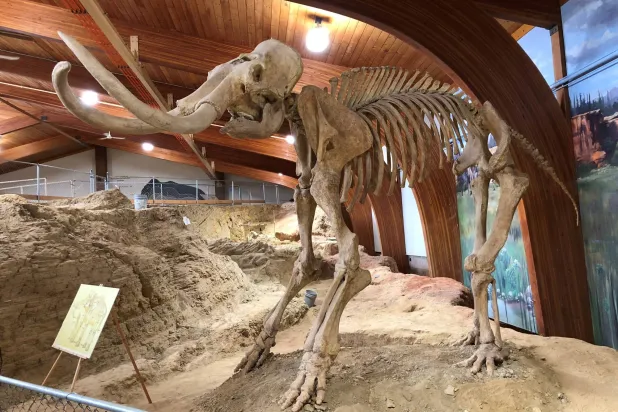
Study Shows Prehistoric People Targeted Female Mammoths
Summarized and contextualized by DistantNews.
At a glance
News
Named sources
Outcome reported
- Ice Age people in Eurasia and North America primarily hunted female woolly mammoths, according to new research using genetic data.
- Approximately 70% of mammoth bones found at human accumulation sites were female, compared to 34% from natural settings, suggesting selective hunting.
- Researchers hypothesize that female mammoths, potentially living in matriarchal herds like modern elephants, were easier to track and target due to more predictable movement patterns.
Prehistoric hunters in Eurasia and North America showed a distinct preference for targeting female woolly mammoths, a new study reveals. These massive creatures were a vital resource, providing substantial meat and fat, durable hides for clothing, and bones and tusks for tools, weapons, and art. Even their largest bones served as construction material for shelters.
That's a great question, and one we're still actively investigating.
Analysis of genetic data from mammoth bones at 11 sites across Poland, Austria, the Czech Republic, Germany, and Russia uncovered a significant sex disparity in hunted animals. Around 70% of mammoths from these human-made accumulation sites were female, contrasting sharply with the 34% female ratio found in mammoth bones from natural death sites. This suggests a deliberate and selective hunting strategy by Ice Age peoples.
One possibility is that if woolly mammoths lived in female-led herds like modern elephants, those groups may have moved across the landscape in more predictable, seasonal ways.
Scientists are exploring several theories to explain this pattern. One leading hypothesis, proposed by Hannah Moots, a postdoctoral researcher at the Centre for Palaeogenetics, suggests that if woolly mammoths lived in female-led herds, similar to modern elephants, their more predictable, seasonal movements might have made them easier targets. "Female elephant herds have relatively stable home ranges and movement patterns, whereas adult males are more solitary and often roam much more widely," Moots explained, as quoted by Reuters. This predictability could have allowed hunters to repeatedly locate and ambush these herds.
Today, female elephant herds have relatively stable home ranges and movement patterns, whereas adult males are more solitary and often roam much more widely.
Another contributing factor could be the physical differences between male and female mammoths. Female mammoths were generally smaller than males, with adult females weighing up to 4 tons and standing about 9.5 feet tall, compared to males that could reach up to 6 tons and 11 feet at the shoulder. Love Dalén, an evolutionary geneticist and co-senior author of the study, also speculated that herds with juveniles might have been easier to corner, as the females would be less likely to flee. The nomadic hunter-gatherers of the Ice Age, who also hunted woolly rhinoceroses and caribou, may have used the landscape itself to their advantage, potentially driving mammoths into traps or difficult terrain.
One could also speculate that it would have been easier to pin down a herd with juveniles, where the females would have been reluctant to run away.
DistantNews Editorial
Originally published by Asharq Al-Awsat. Summarized and contextualized by our editorial team with added local perspective. Read our editorial standards.
More Stories



From Our Blog

What Gets Lost (and Found) When News Is Translated

The Critical Role of Diaspora Media in Global News

What Travellers Should Know About Countries with Restricted Press

A Digital Nomad's Guide to Following Local News

How the Same Story Looks Different in Different Countries
