


🇩🇪
Germany
Super-fluffy celestial bodies: Lighter than cotton candy: Planet with extremely low density
Translated from German, summarized and contextualized by DistantNews.
At a glance
News
From a news agency
Context piece
- Two giant planets orbiting the star TOI-791, located 1,100 light-years away, have an extremely low density, comparable to cotton candy.
- These planets are as large as Jupiter but possess only about one-thirtieth of its mass, a rarity that fascinates scientists.
- Researchers hope further observations will shed light on the formation and evolution of these unusual celestial bodies.
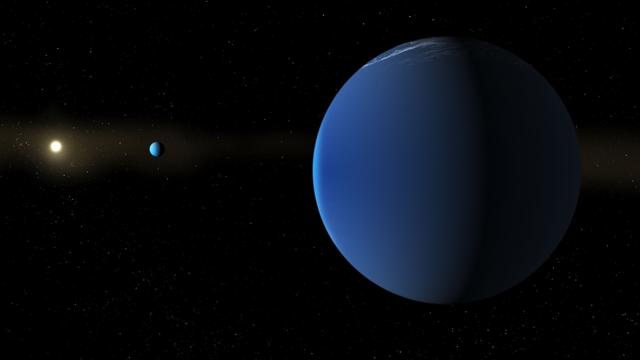
Astronomers have discovered two "super-fluffy" planets orbiting the distant star TOI-791, boasting a density lower than cotton candy. These gas giants, located 1,100 light-years from Earth, are comparable in size to Jupiter but contain merely one-thirtieth of its mass. This discovery, reported in "Monthly Notices of the Royal Astronomical Society," marks a significant find as such planets are exceptionally rare.
"Finding two such planets in one system is an even greater rarity," said lead author Georgina Dransfield of the University of Oxford. "Their extremely low density makes them fascinating testbeds for our understanding of planet system formation and evolution."
The planets were initially detected in archival data from NASA's Transiting Exoplanet Survey Satellite (TESS) by amateur astronomers in 2019 and 2023. TESS monitors the brightness of millions of stars to identify potential planets. When a planet passes in front of its star from Earth's perspective, it causes a slight, regular dimming of the star's light, revealing its presence.
By analyzing the dimming during these transits, scientists determined the planets' sizes. Further observations of slight irregularities in the transits allowed researchers to calculate the planets' masses. The surprisingly low mass led to the calculation of an average density of about 0.04 grams per cubic centimeter, even less than the typical density of cotton candy (0.05 g/cm³). For comparison, Earth's average density is 5.5 g/cm³, and Jupiter's is 1.3 g/cm³.
Scientists do not believe these planets are literally fluffy. Instead, they hypothesize that the planets' large size and low density are due to extensive gas or dust envelopes. These envelopes might surround a relatively small, dense core of rock and metal, creating the illusion of extreme lightness. Further study is needed to understand the precise mechanisms behind their formation and evolution.
DistantNews Editorial
Originally published by Die Zeit in German. Translated, summarized, and contextualized by our editorial team with added local perspective. Read our editorial standards.
More Stories



From Our Blog

What Gets Lost (and Found) When News Is Translated

How the Same Story Looks Different in Different Countries

The Critical Role of Diaspora Media in Global News

What Travellers Should Know About Countries with Restricted Press

A Digital Nomad's Guide to Following Local News
