

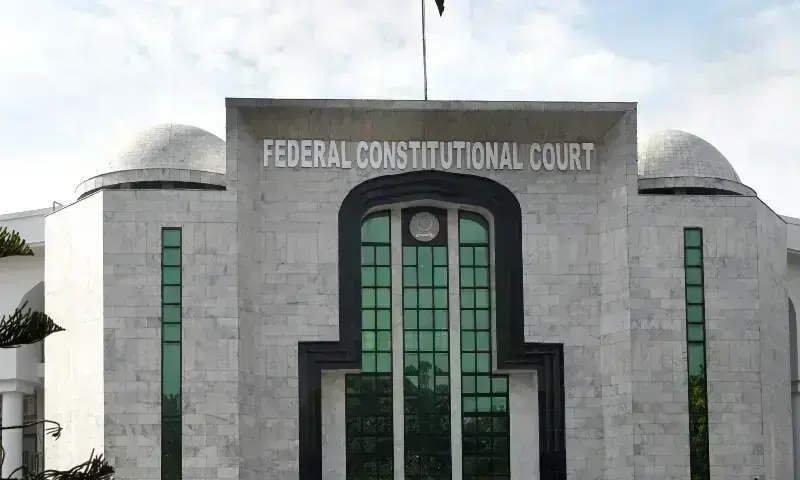

Superior Courts Should Sparingly Direct High Courts on Case Speed, Pakistan FCC Rules
Translated from English, summarized and contextualized by DistantNews.
At a glance
News
Named sources
Context piece
- Pakistan's Federal Constitutional Court (FCC) ruled that superior courts should sparingly issue directives to high courts for expeditious case decisions.
- The ruling came after the National Cyber Crime Investigation Agency (NCCIA) challenged a Supreme Court order for the Islamabad High Court to decide a case within two weeks.
- The FCC emphasized the independent judicial and administrative functions of high courts, stating that directives overriding case management schemes constitute an intrusion.
Pakistan's Federal Constitutional Court (FCC) has issued a significant ruling stating that superior courts should exercise restraint when directing high courts to expedite pending cases. The court emphasized that such directives should be used sparingly and phrased carefully.
directions to the high courts for expeditious decisions in pending matters by superior courts should be issued sparingly and couched in appropriate words.
This judgment follows a recent petition filed by the National Cyber Crime Investigation Agency (NCCIA). The NCCIA challenged a Supreme Court order from May 12, 2026, which mandated the Islamabad High Court (IHC) to decide within two weeks the pleas for sentence suspension for human rights lawyers Imaan Zainab Mazari-Hazir and Hadi Ali Chattha. The NCCIA argued that such orders undermine the "sanctity and independence of the judiciary" and could lead to discrimination.
In a three-page order authored by Justice Aamer Farooq, the FCC addressed a dispute between Gujranwala Electric Power Company (Gepco) and Master Tiles and Ceramics Industries Ltd. The court held that high courts possess independent rosters, case management systems, and policies for case fixation. Any order or directive that imposes case fixation, the FCC stated, amounts to an intrusion into the judicial and administrative independence of the high court.
any order or direction, which superimposes case fixation, amounts to intrusion in the judicial and administrative independence of high court.
The FCC bench, led by Justice Farooq and including Justice Syed Arshad Hussain Shah, set aside the IHC's earlier order. However, it directed that the writ petitions filed by Master Tiles would be considered pending before the IHC, with an expectation of prompt attention due to the case's urgency. The court reiterated that high courts are independent constitutional courts, not subordinate to the Supreme Court or the FCC, despite their decisions being challengeable.
The high court, so created, is an independent constitutional court and is not subordinate to either the SC or FCC.
DistantNews Editorial
Originally published by Dawn in English. Translated, summarized, and contextualized by our editorial team with added local perspective. Read our editorial standards.
More Stories



From Our Blog

What Gets Lost (and Found) When News Is Translated

The Critical Role of Diaspora Media in Global News

What Travellers Should Know About Countries with Restricted Press

A Digital Nomad's Guide to Following Local News

How the Same Story Looks Different in Different Countries
