


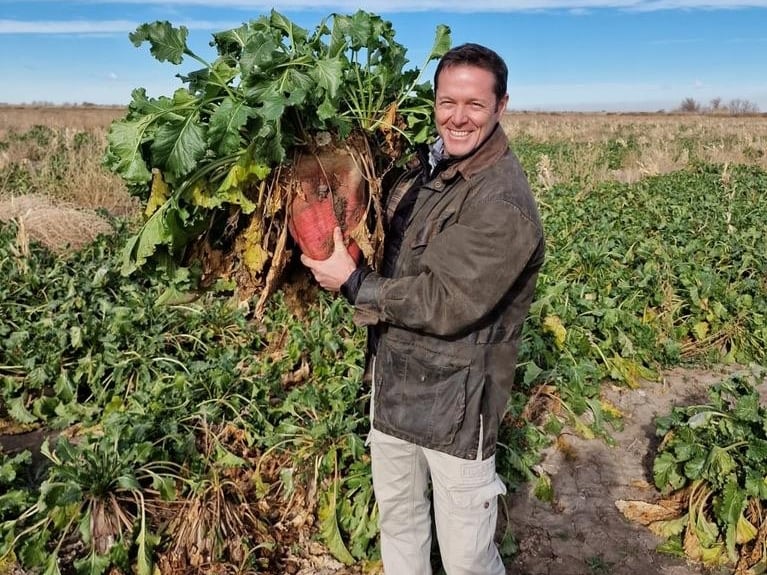
Surprise: The forage beet boom that's revolutionizing meat production
Translated from Spanish, summarized and contextualized by DistantNews.
At a glance
News
Sources not specified
Context piece
- Forage beet cultivation is revolutionizing cattle fattening in Argentina, producing up to 3,500 kg of meat per hectare in six months at a low cost.
- This system, inspired by New Zealand and Australia, offers a sustainable and efficient alternative to traditional extensive farming.
- The forage beet, a variety of Beta vulgaris, is highly energetic and nutritious, providing a balanced diet for cattle and significantly increasing meat production.
The use of forage beet in cattle fattening systems is creating a significant impact in Argentina, with producers achieving remarkable results. One producer, Alejandro Pérez Iturbe, has demonstrated that this method can yield between 2,300 and 3,500 kg of meat per hectare within just six months, at a highly competitive cost of approximately US$0.50 per kilogram of meat produced.
This innovative approach is based on production models implemented at Pérez Iturbe's farm, Don Antuco, in Carmen de Patagones. His system is a replication of practices he observed during a technical trip to New Zealand and Australia in 2017. What began as an agronomic curiosity has evolved into a concrete alternative: the intensive cultivation of Beta vulgaris, a high-energy forage beet capable of supporting a sustainable fattening system, even during winter months.
Under high-productivity scenarios, with 30 to 36 tons of dry matter per hectare, the system can support over 20 animals per hectare, with daily weight gains ranging from 750 to 900 grams per animal. This method not only enhances efficiency during winter when green forage is scarce but also triples or quadruples meat production compared to traditional extensive systems, with an estimated gross margin of US$800 per hectare. The model is actively redefining productive systems, and notably, the beet itself is also suitable for human consumption.
At first, you'd say it's a bit of money, just another crop. We didn't give it much importance. The second time we saw it, there were 50 Charolais steers, 500 kg each, eating, and it was something else.
Pérez Iturbe recounted his initial skepticism, recalling how he first saw cattle being fed forage beets in New Zealand and Australia eight years prior. Initially viewing it as just another crop, he became convinced of its potential after seeing 50 Charolais cattle, each weighing 500 kg, thriving on the beet diet. Six years ago, after researching with seed companies, he began developing the system on his farm using animal-suitable Beta vulgaris varieties. His initial investment of US$1,700 per hectare for establishment was followed by further expenses as the project developed.
Historically, concerns existed about cattle consuming beets due to potential toxins. However, the forage beet, derived from sugar beet, possesses high energy content (3 megacalories per kilogram of dry matter), comparable to corn grain. Furthermore, its leaves are rich in protein. This combination of energy in the root and protein in the leaves creates a balanced and optimal diet for fattening cattle, revolutionizing meat production efficiency.
I started by planting seven hectares on the farm, and a couple more hectares were planted in the Choele-Choel area to test and see if it worked. It worked very well, and the development of the plants was spectacular. It was so revolutionary that it accelerated the process.
DistantNews Editorial
Originally published by La Nación in Spanish. Translated, summarized, and contextualized by our editorial team with added local perspective. Read our editorial standards.
More Stories



From Our Blog

What Gets Lost (and Found) When News Is Translated

The Critical Role of Diaspora Media in Global News

What Travellers Should Know About Countries with Restricted Press

A Digital Nomad's Guide to Following Local News

How the Same Story Looks Different in Different Countries
