


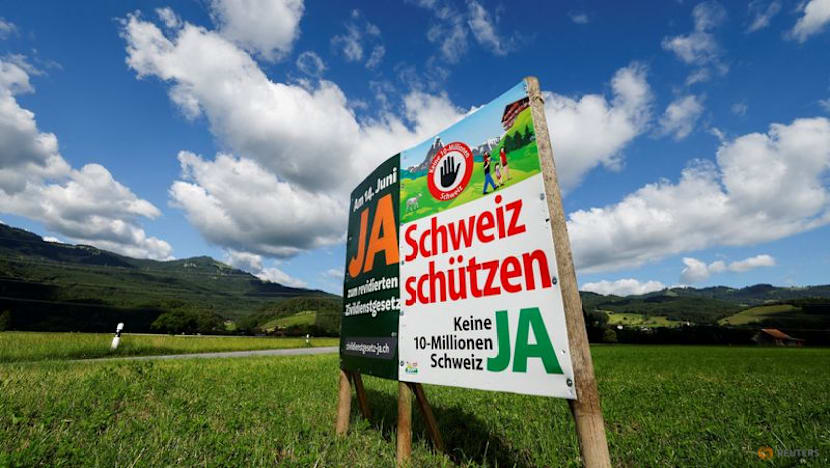
Swiss Reject Population Cap in Referendum, Avoiding EU Clash and Cheering Business
Translated from English, summarized and contextualized by DistantNews.
At a glance
News
Named sources
Outcome reported
- Swiss voters rejected a proposal to cap the country's population at 10 million, prioritizing economic stability and EU ties.
- The referendum, similar to Britain's Brexit vote, could have ended free movement of labor with the EU, Switzerland's main trading partner.
- While the 'no' vote prevailed, concerns about immigration and strained public services remain, prompting pledges for further analysis and action.
Switzerland has decisively rejected a proposal to cap its population at 10 million, a move that had raised concerns about potential clashes with the European Union and economic disruption. Voters opted for economic stability and continued free movement of labor with the EU, Switzerland's primary trading partner, over anxieties about immigration straining public services and increasing rents.
With today's decision, the electorate has sent out a signal of stability, openness, and reliability.
The referendum, championed by the right-wing Swiss People's Party (SVP), stipulated that the population should not exceed 10 million by 2050, with a provision to end freedom of movement with the EU if the cap was breached for two consecutive years. The government had actively campaigned against the proposal, urging voters to reject it.
Preliminary results showed nearly 55 percent of voters opposed the cap, with 45 percent in favor. Swiss Justice Minister Beat Jans welcomed the outcome, calling it a "signal of stability, openness, and reliability." However, he acknowledged the underlying concerns about housing and immigration, pledging to explore further measures to address these issues. Pollster GFS Bern noted that while population growth is a widespread concern, voters feared the cap's negative impact on Swiss-EU relations and the difficulty in recruiting essential workers.
Also there's a feeling that in the current international environment, it's not sensible for a small country to do this.
The Swiss population currently stands at 9.1 million, with foreign nationals comprising nearly 28 percent. Official projections anticipate reaching the 10 million mark by the early 2040s. Despite the clear rejection of the cap, some, like Zurich schoolteacher Jan Hesselmann, expressed concern over the proposal's significant support, viewing it as a potential fuel for xenophobia amidst a broader European trend towards curbing immigration.
It's the wrong way to go about it, it fuels xenophobia.
DistantNews Editorial
Originally published by CNA in English. Translated, summarized, and contextualized by our editorial team with added local perspective. Read our editorial standards.
More Stories



From Our Blog

What Gets Lost (and Found) When News Is Translated

The Critical Role of Diaspora Media in Global News

What Travellers Should Know About Countries with Restricted Press

A Digital Nomad's Guide to Following Local News

How the Same Story Looks Different in Different Countries
