

Taegeukgi Flag from Syngman Rhee's New York Independence Dinner Restored After 84 Years
Translated from Korean, summarized and contextualized by DistantNews.
At a glance
News
Sources not specified
Outcome reported
- A South Korean national treasure, a Taegeukgi flag used during a 1942 independence dinner in New York, has been restored after 84 years.
- The flag, made by Copeland Company in the 1930s, was used by Syngman Rhee at the Waldorf Astoria Hotel and is significant for its unique overseas production techniques and its connection to the Korean independence movement.
- The restoration process involved scientific analysis to reveal its construction methods and meticulous cleaning and repair to address discoloration and damage from moisture and wear.
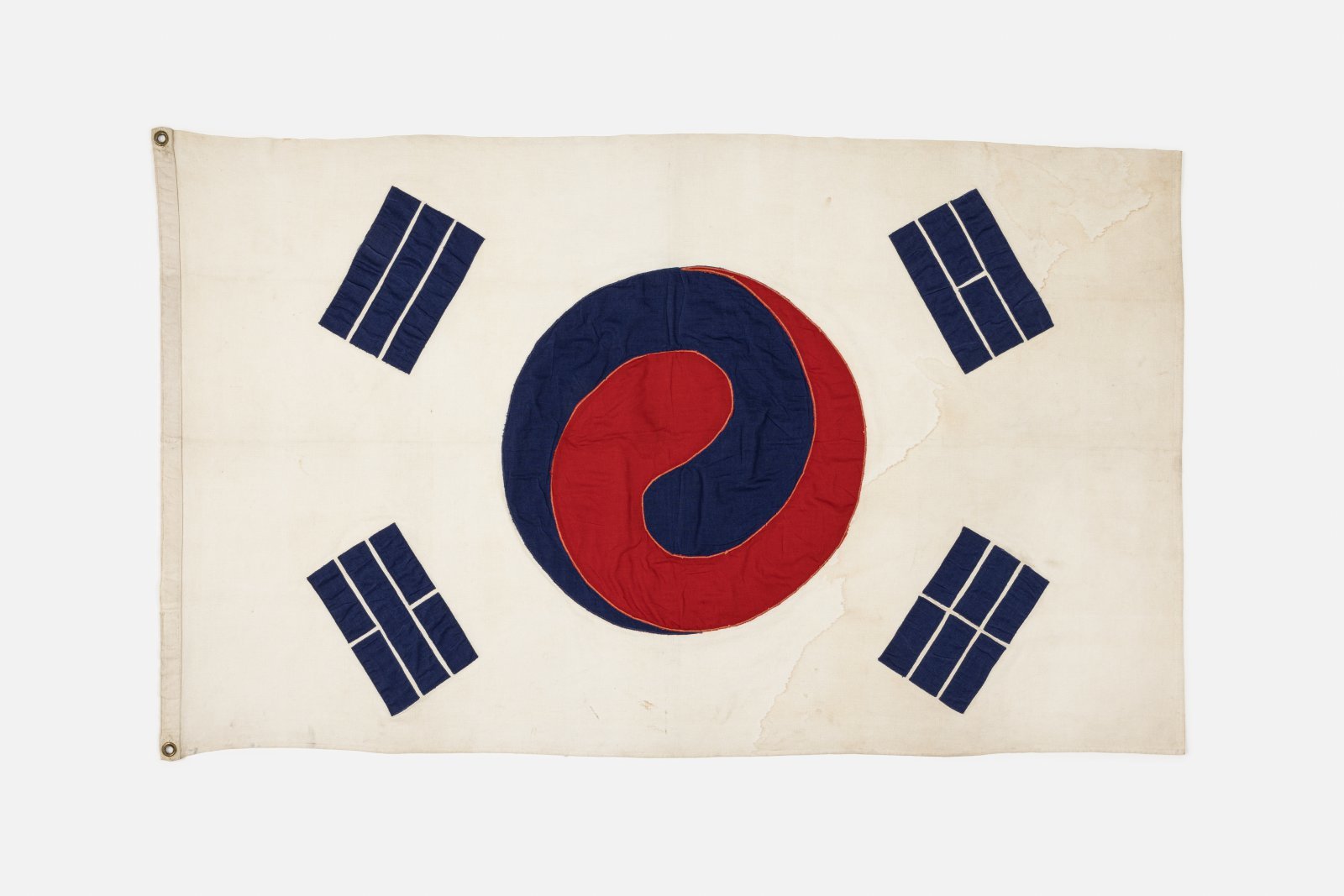
A South Korean national treasure, a Taegeukgi flag used during a 1942 independence dinner in New York, has been restored after 84 years, regaining its original form through scientific preservation treatment.
The flag, originally crafted by the American company Copeland Company in the 1930s, was utilized by Syngman Rhee, the first president of South Korea, during a Korean independence dinner held at the Waldorf Astoria Hotel in New York in 1942. It holds significant historical value, not only for revealing unique production techniques of Korean flags made abroad but also as a crucial piece of evidence testifying to the intense moments of Korea's struggle for independence. Recognizing its importance, the flag was designated a national registered cultural heritage in 2008.
The restoration project uncovered new details about the flag's construction through scientific analysis. The white fabric featured intricately sewn Taegeuk and trigram symbols. The Taegeuk emblem was found to be constructed by first applying blue fabric and then layering red fabric on top. Notably, the hoist side, used for attaching to a flagpole, was woven in a twill weave with a diagonal pattern, while the main flag and the symbols used a plain weave with two-ply threads, indicating different weaving techniques were applied to different parts.
Before the restoration, the flag, which had been preserved in a frame for a long time, showed significant yellowing across its surface. The right side, where the 'Gon' and 'Lee' trigrams are located, was heavily stained by moisture. Some stitching had also come undone as the fabric of the Taegeuk and trigrams folded or creased.
Researchers carefully removed the flag from its frame and cleaned off residual adhesive from the back. Wrinkled areas were humidified with a fine mist and then stabilized by applying pressure. Yellowed areas and moisture stains were first removed using a soft brush and a vacuum aspirator. Subsequently, a partial wet cleaning method using 'Agarose Gel,' a polysaccharide substance derived from red algae, was employed to minimize moisture diffusion. Damaged stitching was reinforced along the original seams, minimizing visible repair traces to preserve the flag's original form and ensure its stability. The restored flag is scheduled to be transferred to the National Assembly Archives, its designated repository.
DistantNews Editorial
Originally published by Dong-A Ilbo in Korean. Translated, summarized, and contextualized by our editorial team with added local perspective. Read our editorial standards.
More Stories


From Our Blog

What Gets Lost (and Found) When News Is Translated

The Critical Role of Diaspora Media in Global News

What Travellers Should Know About Countries with Restricted Press

A Digital Nomad's Guide to Following Local News

How the Same Story Looks Different in Different Countries
