


The Empire That Ruled the Roads: Persia Bound Civilization Not by 'Swords' but by 'Fusion Aesthetics' [Yang Jeong-moo's Art and Economy]
Translated from Korean, summarized and contextualized by DistantNews.
TLDR
- The ancient Persian Empire, which spanned vast territories, established an efficient communication system through the 'Royal Road,' enabling swift message delivery across its domain.
- Persian rule, known as 'Pax Persiana,' was characterized by tolerance and the integration of diverse cultures and architectural styles, fostering a sense of shared prosperity.
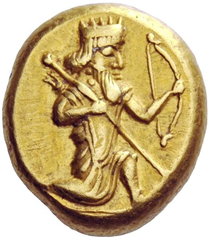
- The empire pioneered the use of gold coins ('Daric') to facilitate trade along the Royal Road, symbolizing its economic prowess and facilitating exchange across its extensive network.
The legacy of the Achaemenid Persian Empire, stretching from modern-day Iran, offers profound lessons in governance, cultural integration, and economic innovation that resonate even today. As explored in this piece, Persia was not merely a conqueror but a sophisticated architect of empire, building a civilization that embraced diversity and facilitated unprecedented connectivity.
Neither snow, nor rain, nor heat, nor gloom of night stays these couriers from the swift completion of their appointed rounds.
The 'Royal Road' stands as a testament to Persian ingenuity. This vast network of roads, complete with relay stations for swift communication, predates modern postal services and highway systems by millennia. It allowed for the rapid transmission of information and goods, essential for managing a sprawling empire. The famous inscription, "Neither snow, nor rain, nor heat, nor gloom of night stays these couriers from the swift completion of their appointed rounds," originally describing Persian messengers, later became the motto of the U.S. Postal Service, highlighting the enduring impact of Persian infrastructure.
Your Majesty, there is no royal road to geometry.
Beyond its logistical achievements, Persia's approach to ruling, termed 'Pax Persiana,' was remarkably inclusive. Unlike many empires that imposed a singular culture, Persia allowed conquered peoples to retain their religions and customs, as exemplified by Cyrus the Great's decree allowing the Jews to return to Jerusalem. This policy of tolerance was reflected in its art and architecture, particularly in the magnificent city of Persepolis, where diverse styles from across the empire were harmoniously blended. This fusion of cultures was not just aesthetic; it was a political strategy that fostered loyalty and stability.
The Persian Empire, known as the first great empire in human history, integrated the Egyptian, Mesopotamian, and Indus civilizations, excluding the Yellow River civilization.
Furthermore, the introduction of the 'Daric,' a standardized gold coin, revolutionized trade within the empire and beyond. This economic innovation, facilitated by the Royal Road, spurred commerce and contributed to the empire's prosperity. From our perspective in Iran, understanding these historical achievements is crucial. It reminds us of a time when our region was at the forefront of civilization, pioneering systems of governance and economic exchange that shaped the world. While Western narratives often focus on military conquests, the Persian genius lay in its ability to unite diverse peoples through infrastructure, tolerance, and economic foresight—a model of empire building that remains relevant.
The Persian Empire practiced tolerance and assimilation policies early on, winning people's hearts through benevolent governance alongside its strong military power.
DistantNews Editorial
Originally published by Dong-A Ilbo in Korean. Translated, summarized, and contextualized by our editorial team with added local perspective. Read our editorial standards.
More Stories


From Our Blog

What Gets Lost (and Found) When News Is Translated

The Critical Role of Diaspora Media in Global News

What Travellers Should Know About Countries with Restricted Press

A Digital Nomad's Guide to Following Local News

How the Same Story Looks Different in Different Countries
