


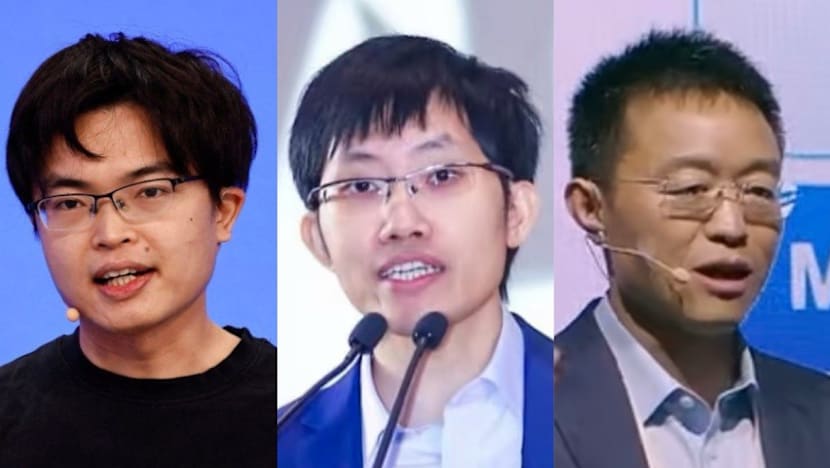
The faces behind China's AI rise: Meet the founders of DeepSeek, Z.ai and Moonshot AI
Summarized and contextualized by DistantNews.
At a glance
News
Named sources
Context piece
- China is emerging as a major competitor in the global AI race, with startups releasing advanced models that rival US alternatives.
- DeepSeek founder Liang Wenfeng, now the world's richest AI model creator, invested heavily in computing power before US sanctions.
- Liang aims for China to transition from a technology beneficiary to a core innovator in AI development.
China is rapidly asserting itself as a significant player in the global artificial intelligence arena, with its startups releasing sophisticated AI systems that challenge established US alternatives. Companies like DeepSeek, Z.ai, and Moonshot AI are at the forefront, pushing the boundaries of AI development with models such as Kimi K3 and GLM-5.2.
Liang Wenfeng, the founder of Hangzhou-based DeepSeek, has become a prominent figure in this surge. His company made waves in 2025 with the release of its R1 model, claimed to be on par with US competitors but at a significantly lower cost. Liang, who previously co-founded a successful quantitative hedge fund, strategically invested over 10,000 Nvidia chips before US sanctions took effect, securing crucial computing power for DeepSeek, which was established in 2023.
This foresight has propelled Liang to the top of the AI wealth rankings, with his net worth soaring to $37.9 billion, far surpassing other AI leaders. Unlike many Chinese startups, Liang initially self-funded DeepSeek, leveraging profits from his hedge fund. However, as costs escalated and the company pursued its own inference AI chip development, it recently secured approximately $7.4 billion in its first venture capital funding round.
DeepSeek's latest V4 model, released in April, boasts drastically reduced costs. Despite the company's growing prominence, Liang has largely remained out of the public eye. In a rare 2024 interview, he articulated his vision for DeepSeek and China's AI future, emphasizing the nation's need to evolve from a technology consumer to a primary innovator. He noted that many Chinese companies have become accustomed to adapting foreign innovations rather than pioneering core inventions.
China must move from a beneficiary of technology to a contributor.
DistantNews Editorial
Originally published by CNA. Summarized and contextualized by our editorial team with added local perspective. Read our editorial standards.
More Stories
From Our Blog

What Gets Lost (and Found) When News Is Translated

The Critical Role of Diaspora Media in Global News

What Travellers Should Know About Countries with Restricted Press

A Digital Nomad's Guide to Following Local News

How the Same Story Looks Different in Different Countries
