

The German town that prints its own money to cut emissions
Summarized and contextualized by DistantNews.
At a glance
News
Sources not specified
Context piece
- The German town of Traunstein in Bavaria uses a local currency called the "Chiemgauer" to support regional businesses and reduce carbon emissions.
- Launched in 2003 by a high school economics teacher and students, the Chiemgauer keeps money circulating within the region, with €1 equaling one Chiemgauer.
- The currency requires users to purchase small stamps every six months to remain valid, encouraging circulation and funding the system's operations, with a 5% fee for businesses converting Chiemgauers to euros.
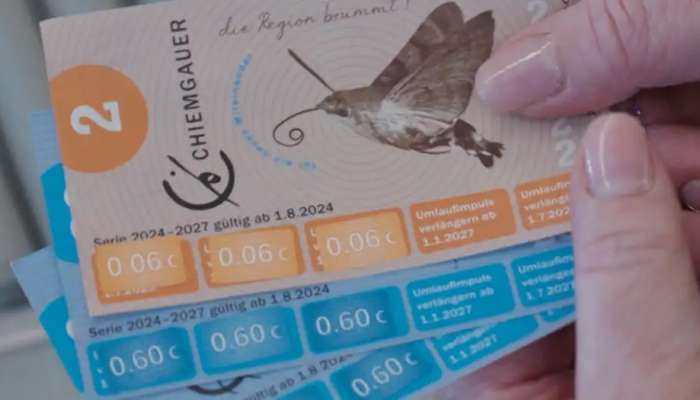
In Bavaria's Chiemgau region, a unique local currency known as the "Chiemgauer" is not only supporting local businesses but also actively contributing to carbon emission reduction efforts. This colorful, insect-themed currency, which looks like play money, has been in circulation for over two decades, underpinning a micro-financial system.
An estimated 10 to 15% of customers pay this way.
The Chiemgauer originated in 2003 as a high school economics project aimed at helping local businesses compete against larger chains. The idea was to create a currency that would circulate exclusively within the region. Today, approximately €5 million worth of Chiemgauers are spent annually, with one Chiemgauer equivalent to one euro. The currency is managed by the association Chiemgauer e.V., based in Traunstein. While printing and using non-euro currencies can be illegal in Germany, the Chiemgauer is tolerated by the Deutsche Bundesbank due to its regional confinement and limited user base of around 4,200 individuals and 300 businesses.
Five million Chiemgauers are being spent annually now.
To maintain the currency's circulation, users must purchase small stamps every six months; for instance, a 10-Chiemgauer note requires a stamp costing about €0.30. After three years, the notes expire entirely for private users. Businesses can convert their Chiemgauers to euros, but a 5% fee is applied, which helps fund the currency's operations. This system ensures that money stays within the local economy, fostering community support and sustainability.
These are more than 200,000 Chiemgauers, worth the same amount in euros.
DistantNews Editorial
Originally published by Times of Oman. Summarized and contextualized by our editorial team with added local perspective. Read our editorial standards.
More Stories



From Our Blog

What Gets Lost (and Found) When News Is Translated

The Critical Role of Diaspora Media in Global News

What Travellers Should Know About Countries with Restricted Press

A Digital Nomad's Guide to Following Local News

How the Same Story Looks Different in Different Countries
