


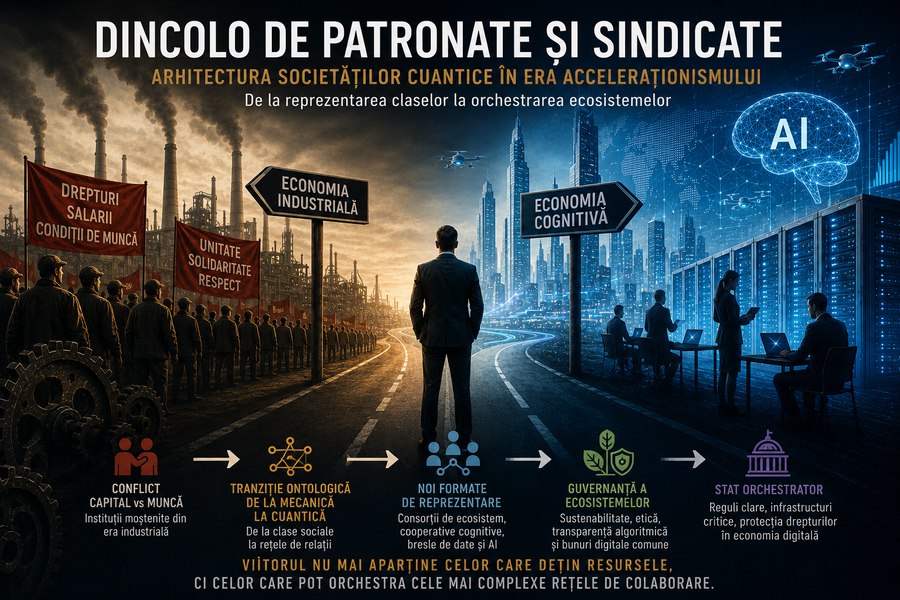
The Last Strike: Why Unions and Employers Are Disappearing in the Era of Collective Intelligence. The Obsolescence of Class Representation in the Age of Cognitive Accelerationism
Translated from Romanian, summarized and contextualized by DistantNews.
At a glance
Analysis
Sources not specified
Context piece
- The article argues that labor unions and employer associations are becoming obsolete in the era of collective intelligence and platform economies.
- It suggests a shift from class-based representation to a "quantum governance" model based on cognitive cooperatives and data sovereign funds.
- This transition is driven by disruptive technologies like AI and decentralized networks, leading to new institutional models.
In the current era of collective intelligence and platform economies, traditional institutions like labor unions and employer associations are facing obsolescence, according to an analysis. The article posits a fundamental shift from class-based representation to a new form of governance, termed "quantum governance."
This emerging model is characterized by cognitive cooperatives, data sovereign funds, and a humanist transition towards integrated ecosystem networks. The author anchors this argument in established theoretical frameworks, citing scholars like Alexander Wendt, Nick Srnicek, and Jodi Dean, to emphasize that anticipating future institutional architectures requires engagement with mature international theoretical dialogues.
The analysis examines the structural mutation of social and economic representation institutions under the impact of disruptive technologies such as artificial intelligence, decentralized networks, and advanced computing. It hypothesizes a transition from a classical, Newtonian social ontology, based on rigid categories and bipolar production relations, to a quantum ontology that is fluid, reticular, and probabilistic.
Within this quantum framework, class-based representation is gradually being replaced by the governance of integrated ecosystems. New conceptual institutional models, including ecosystem consortia, cognitive cooperatives, data guilds, and independent algorithmic authorities, are emerging. The article critically analyzes both their potential for democratization and the risk of sliding into a form of technological neo-feudalism, observing how these new holistic ecosystem models progressively render classical structures irrelevant.
DistantNews Editorial
Originally published by Adevărul in Romanian. Translated, summarized, and contextualized by our editorial team with added local perspective. Read our editorial standards.
More Stories



From Our Blog

What Gets Lost (and Found) When News Is Translated

The Critical Role of Diaspora Media in Global News

What Travellers Should Know About Countries with Restricted Press

A Digital Nomad's Guide to Following Local News

How the Same Story Looks Different in Different Countries
