


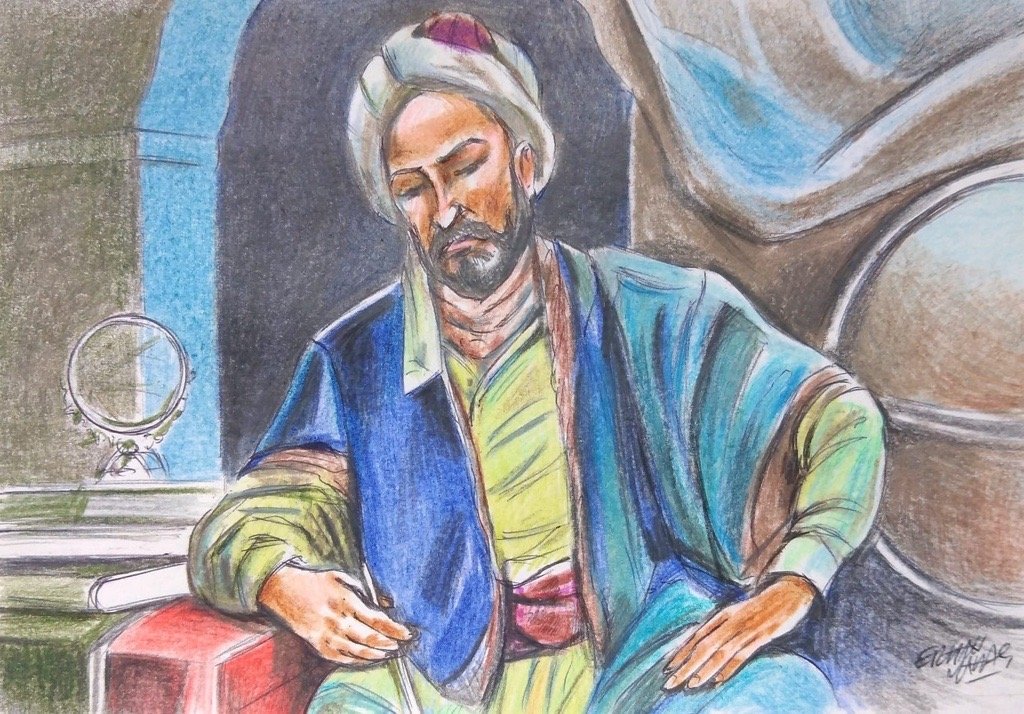
The timeless legacy of Nasir al-Din al-Tusi
Summarized and contextualized by DistantNews.
At a glance
In-depth
Sources not specified
Context piece
- - Nasir al-Din al-Tusi, a prominent Islamic scholar, significantly influenced mathematics, astronomy, and ethics.
- He founded the Maragha School of Mathematics and Astronomy, which paved the way for the Samarkand School and later influenced Ottoman scholarship.
- Al-Tusi's work "Akhlaq-i Nasiri" is a foundational text in Islamic ethics, systematically integrating the ideas of earlier thinkers.
Nasir al-Din al-Tusi holds a distinguished place in the intellectual history of the Islamic world, primarily for his foundational role in establishing the Maragha School of Mathematics and Astronomy. This institution fostered a scholarly tradition that significantly advanced scientific thought and directly influenced the later emergence of the Samarkand School. The intellectual lineage stemming from these schools eventually permeated the Ottoman scholarly tradition, underscoring al-Tusi's lasting impact.
A true polymath, al-Tusi made significant contributions across a wide spectrum of disciplines, including mathematics, astronomy, philosophy, medicine, and ethics. His seminal work, "Akhlaq-i Nasiri" (Nasir's Ethics), stands as one of the most commented-upon texts in Islamic intellectual history and played a crucial role in shaping subsequent ethical studies. The book's importance lies not only in its comprehensive treatment of ethics but also in al-Tusi's systematic reinterpretation and integration of the ethical, political, and anthropological perspectives of earlier philosophers like Ibn Miskawayh, al-Farabi, and Ibn Sina.
Al-Tusi's "Akhlaq-i Nasiri" is structured into three parts, reflecting a deliberate classification of practical philosophy. The first part, "Tahdhib al-Akhlaq" (Moral Cultivation), draws heavily on Ibn Miskawayh's ideas. The second part, "Tadbir al-Manzil" (Household Management), shows the influence of Ibn Sina. The third part, "Siyasat al-Mudun" (Political Governance), is shaped by the thought of al-Farabi. This tripartite division highlights al-Tusi's view that practical philosophy, which guides human conduct towards perfection, must encompass individual ethics, family management, and the principles of political governance, recognizing that the individual's journey is intertwined with the family and the broader society.
The genesis of "Akhlaq-i Nasiri" began with a request for al-Tusi to translate Ibn Miskawayh's "Tahdhib al-Akhlaq." However, al-Tusi found the original work too limited in scope and opted instead to compose an entirely new treatise, resulting in the comprehensive work that has profoundly influenced Islamic ethical thought for centuries. Its status as a foundational text is further cemented by its influence on later works such as Jalal al-Din al-Dawwani’s "Akhlaq-i Jalali" and Kınalızade Ali Efendi’s "Akhlaq-i Alai."
DistantNews Editorial
Originally published by Daily Sabah. Summarized and contextualized by our editorial team with added local perspective. Read our editorial standards.
More Stories



From Our Blog

What Gets Lost (and Found) When News Is Translated

The Critical Role of Diaspora Media in Global News

What Travellers Should Know About Countries with Restricted Press

A Digital Nomad's Guide to Following Local News

How the Same Story Looks Different in Different Countries
