

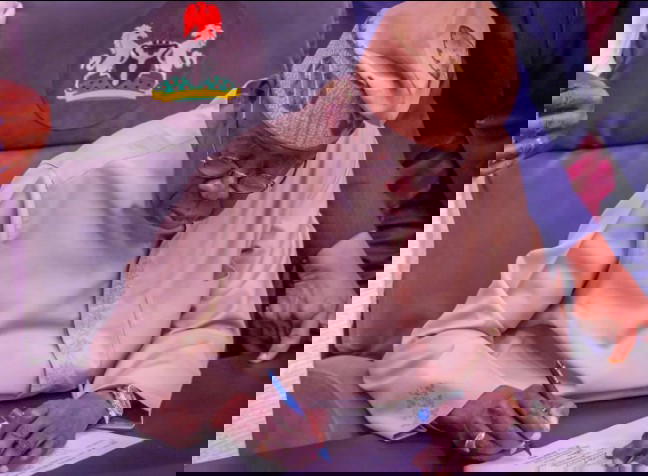

Tinubu Signs Executive Order on Virtual Assets, Establishes Council to Harmonize Crypto Regulation
Translated from English, summarized and contextualized by DistantNews.
At a glance
News
Official statement
New plan
- Nigeria's President Bola Tinubu signed an executive order establishing a new supervisory architecture for virtual assets.
- The order aims to harmonize crypto regulation, close regulatory gaps, and protect citizens from fraud.
- A new Virtual Asset Council, chaired by the Central Bank of Nigeria, will provide policy direction and coordinate agencies.
President Bola Tinubu has signed an executive order establishing a new framework to coordinate and harmonize the regulation of virtual assets in Nigeria. The Presidential Executive Order on Virtual Assets Coordination, 2026, takes immediate effect.
It responds to a regulatory environment that has become fragmented as virtual assets increasingly blur the traditional boundaries between currencies, money, commodities and securities.
The order aims to address regulatory gaps that have allowed fraudulent operators to exploit Nigerians and position the country to benefit from responsible innovation in the digital economy. The Presidency stated that the current fragmented regulatory environment, with agencies operating in silos, has exposed the country to risks such as money laundering, terrorism financing, cybersecurity threats, fraud, and revenue losses.
With relevant agencies operating in silos, overlapping in some areas and leaving gaps in others, the country has been exposed to risks including money laundering, terrorism financing, cybersecurity and data privacy threats, fraud, and revenue losses.
To tackle these issues, the order establishes a Virtual Asset Council. This council will be chaired by the Central Bank of Nigeria, with the Nigeria Revenue Service and the Securities and Exchange Commission as vice-chairs. The Nigerian Financial Intelligence Unit and the Office of the National Security Adviser will also be members. The council's role is to provide policy direction, foster synergy among agencies, and collaborate with the Attorney-General of the Federation to develop a harmonized legal and institutional framework.
Too often, unregistered and fraudulent operators have exploited these gaps to prey on unsuspecting Nigerians, costing families their savings.
An operational body, the Virtual Asset Office, will serve as the council's secretariat, domiciled at the Central Bank of Nigeria. This office will manage the day-to-day coordination of information sharing, applications, and reporting among agencies, supported by a technology platform for shared visibility. The Presidency emphasized that the order does not create a new regulator or transfer powers, but rather coordinates existing agencies' work. Activities involving securities will be registered by the SEC, while non-security virtual assets will be registered by the CBN.
Each institution retains its full statutory mandate and independence, and the framework coordinates their work rather than replacing it.
DistantNews Editorial
Originally published by The Punch in English. Translated, summarized, and contextualized by our editorial team with added local perspective. Read our editorial standards.
More Stories


From Our Blog

How the Same Story Looks Different in Different Countries

What Gets Lost (and Found) When News Is Translated

The Critical Role of Diaspora Media in Global News

What Travellers Should Know About Countries with Restricted Press

A Digital Nomad's Guide to Following Local News
