

Tokayev and Putin Discuss Ukraine, Nuclear Energy and Strategic Partnership in Omsk
Summarized and contextualized by DistantNews.
At a glance
News
Named sources
Context piece
- Kazakhstan President Kassym-Jomart Tokayev met with Russian President Vladimir Putin in Omsk to discuss the war in Ukraine, strategic partnership, and nuclear energy cooperation.
- Tokayev suggested freezing the conflict in Ukraine, referencing the Istanbul peace talks, and ruled out Kazakhstan's role as a mediator.
- The leaders also discussed progress on building Kazakhstan's first nuclear power plant near Lake Balkhash, seen as a project to bring their countries and peoples closer.
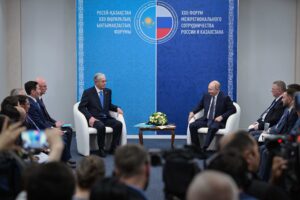
Kazakhstan President Kassym-Jomart Tokayev met with his Russian counterpart Vladimir Putin in Omsk on July 25, ahead of the XXII Kazakhstan-Russia Interregional Cooperation Forum. While the forum focused on transport, logistics, and regional economic ties, the leaders' discussions extended to the war in Ukraine, their strategic partnership, and cooperation on Kazakhstan's upcoming nuclear power plant.
the nature of this conflict is not fully understood by many, including ourselves.
During the meeting, Tokayev articulated his perspective on resolving the Russia-Ukraine conflict, which he has consistently viewed as an interstate dispute. He acknowledged that the conflict's nature is not fully grasped by many, including Kazakhstan. While recognizing that neither side currently possesses a clear path to resolution, Tokayev proposed freezing the conflict as a potential precursor to renewed negotiations. He suggested returning to the framework of the "Istanbul Formula 2.0," where significant progress was made, and seeking guarantees from major powers to move towards peace.
Tokayev explicitly ruled out any mediation role for Kazakhstan, stating that Russia, as a "great country," is capable of resolving the conflict independently. He chose to voice his views publicly due to his planned meeting with Putin. "There is an opportunity to freeze the conflict. This is a well-established mechanism in international practice," he added, expressing concern over the ongoing loss of life, particularly among young people from both nations. Tokayev believes the continuation of the conflict serves the interests of Russia's and Ukraine's adversaries.
Perhaps it is time to freeze this conflict and return to the Istanbul Formula 2.0, because significant results were achieved there. Then, under guarantees from the great powers, including Russia, we could move toward the long-awaited peace.
Reaffirming Kazakhstan's commitment to its strategic partnership and allied relations with Russia, Tokayev stated, "We have always regarded, and continue to regard, Russia as a great state. We remain committed to strategic cooperation with Russia and allied relations, no matter how difficult the circumstances may be." He noted that the interregional forum itself served as further confirmation of this commitment.
There is an opportunity to freeze the conflict. This is a well-established mechanism in international practice.
Furthermore, President Tokayev reported progress on the joint project to construct Kazakhstan's first nuclear power plant near Lake Balkhash. He was informed that field work at the site is nearing completion. Tokayev described the project as more than just a new energy source for Kazakhstan; he sees it as a venture that will foster closer ties between their countries and, crucially, their younger generations, emphasizing training and development.
All of this must be stopped because, in my firm conviction, what is happening serves the interests of and brings satisfaction to the opponents of both Russia and the Ukrainian state.
DistantNews Editorial
Originally published by The Astana Times. Summarized and contextualized by our editorial team with added local perspective. Read our editorial standards.
More Stories
From Our Blog

What Gets Lost (and Found) When News Is Translated

The Critical Role of Diaspora Media in Global News

What Travellers Should Know About Countries with Restricted Press

A Digital Nomad's Guide to Following Local News

How the Same Story Looks Different in Different Countries
