


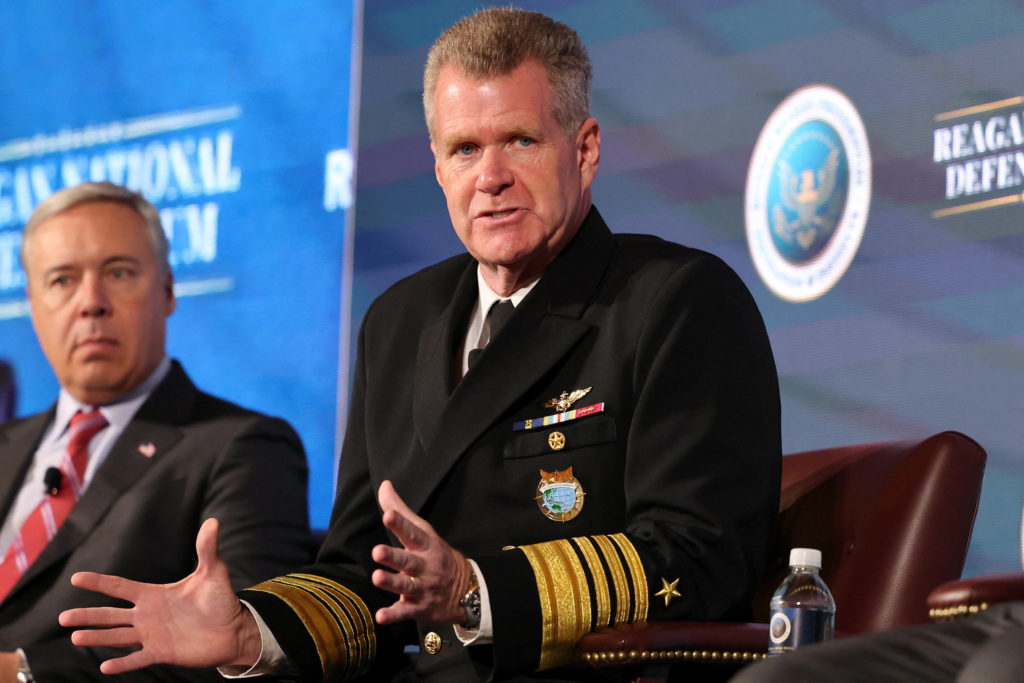
Top U.S. admiral says no nation will dominate Indo-Pacific
Summarized and contextualized by DistantNews.
At a glance
News
Named sources
Context piece
- The head of U.S. Pacific Command stated no nation will be allowed to dominate the Indo-Pacific region.
- Admiral Samuel Paparo warned against coercive actions challenging regional stability.
- He emphasized the U.S. is deterring China through strength, not confrontation, and supports freedom of navigation.
The United States will not permit any nation to dominate the Indo-Pacific, declared Admiral Samuel Paparo, head of U.S. Pacific Command. Speaking via video link at a regional security conference in Malaysia, Paparo asserted that coercive actions by China and other actors are destabilizing the region. He drew a sharp distinction between the "rule of law" and "rule by law," characterizing the latter as using legal frameworks as a weapon of raw power. "That distinction between law as a tool of order versus law as a weapon of raw power, is the defining fault line of our time," Paparo stated.
That distinction between law as a tool of order versus law as a weapon of raw power, is the defining fault line of our time.
Paparo's remarks come amid heightened tensions, particularly in the South China Sea, where China's extensive maritime claims clash with those of several Southeast Asian nations. The Philippines has been a focal point, experiencing repeated confrontations with Chinese vessels around a disputed shoal. Manila accuses Beijing of dangerous maneuvers and blocking resupply missions, accusations China denies while upholding its territorial claims.
The United States is deterring China through strength, not through confrontation.
The U.S. official stressed that while the United States does not take sides on sovereignty disputes, it champions freedom of navigation, international law, and the sovereign rights of nations. "The United States is deterring China through strength, not through confrontation," Paparo said. "We will not let any nation dominate this region or sweep away the hard-fought sovereign rights of independent states."
We will not let any nation dominate this region or sweep away the hard-fought sovereign rights of independent states.
Philippine Defense Secretary Gilberto Teodoro, also speaking at the conference, vowed that his country would continue to resist and "push back" against perceived threats from China. Teodoro expressed broader concerns about Beijing's expanding reach and military presence, citing recent actions beyond the South China Sea as evidence. The region's growing instability underscores the increasing importance of cooperation among allies and partners, Paparo noted, as it remains the world's geopolitical and economic center.
push back
DistantNews Editorial
Originally published by PBS NewsHour. Summarized and contextualized by our editorial team with added local perspective. Read our editorial standards.
More Stories


From Our Blog

How the Same Story Looks Different in Different Countries

What Gets Lost (and Found) When News Is Translated

The Critical Role of Diaspora Media in Global News

What Travellers Should Know About Countries with Restricted Press

A Digital Nomad's Guide to Following Local News
