


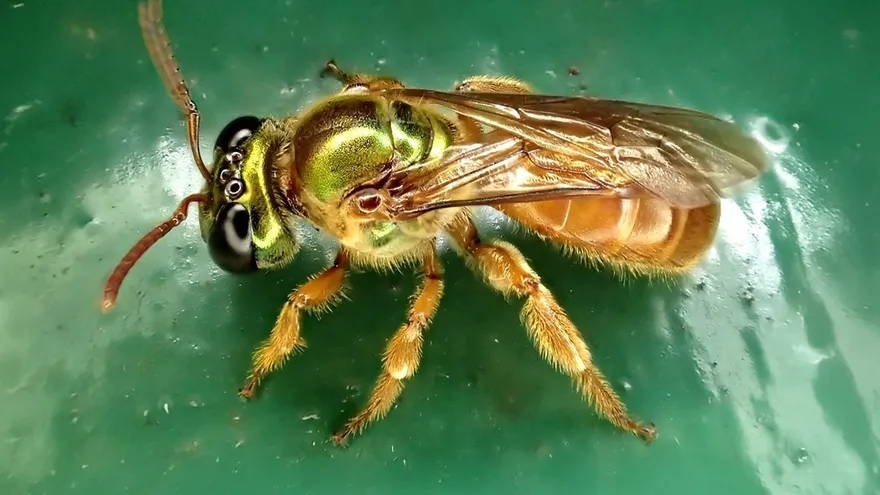
Tropical Bee's 'Chemical Spell' Reveals Clues to Origins of Social Life
Translated from Spanish, summarized and contextualized by DistantNews.
At a glance
News
Named sources
Context piece
- Researchers identified queen pheromones in a tropical sweat bee species, Megalopta genalis, which lives both socially and solitarily.
- This bee's flexible behavior in Panama offers insights into the origins of social life in insects.
- The study found that higher levels of queen pheromones inhibit daughters' reproductive investment and encourage submissive behavior, aiding the stability of early societies.
Scientists at the Smithsonian Tropical Research Institute (STRI) have identified queen pheromones in a unique sweat bee species, Megalopta genalis, found in Panama's forests. This bee can live either in colonies or as a solitary individual, making its adaptable behavior crucial for understanding the evolution of social structures in insects. The findings were published in the journal Proceedings of the Royal Society B.
Megalopta genalis exhibits a fascinating trait: its daughters can choose to remain in the nest as sterile workers assisting the queen or leave to establish their own families. This plasticity provides a valuable opportunity to study the emergence of complex societies, where numerous individuals forgo personal reproduction to support a single queen.
By reliably announcing the queen's laying potential, this pheromone allows daughters to assess whether it is worth staying to help.
Fieldwork conducted on Isla Barro Colorado involved setting up approximately 450 artificial nests and individually marking each bee. Researchers recorded bee behavior on video and analyzed their chemical compounds using gas chromatography and mass spectrometry. A key innovation was performing these analyses directly in the field and repeating them throughout the bees' lives.
Chemical signals like these can stabilize nascent societies, buying time for social complexity to emerge.
The study revealed that elevated levels of queen pheromones suppress daughters' reproductive drive and promote subordinate behavior. Lead author Callum Kingwell explained that this pheromone reliably signals the queen's egg-laying potential, allowing daughters to assess whether staying to help is beneficial. His colleague, Bill Wcislo, added that such chemical signals can stabilize nascent societies by providing time for social complexity to develop.
This discovery not only sheds light on the biology of Megalopta bees, considered a recent origin of sociality, but also has broader implications. Kingwell concluded that chemical communication helps individuals decide when cooperation is worthwhile, a fundamental principle in evolutionary biology and social systems. The research advances the understanding of how chemical signaling facilitated the transition from solitary existence to the large, organized colonies prevalent in ecosystems today.
Chemical communication can help individuals decide when it is worth cooperating, a fundamental principle for evolutionary biology and social systems.
DistantNews Editorial
Originally published by TVN Panamá in Spanish. Translated, summarized, and contextualized by our editorial team with added local perspective. Read our editorial standards.
More Stories



From Our Blog

What Gets Lost (and Found) When News Is Translated

The Critical Role of Diaspora Media in Global News

What Travellers Should Know About Countries with Restricted Press

A Digital Nomad's Guide to Following Local News

How the Same Story Looks Different in Different Countries
