


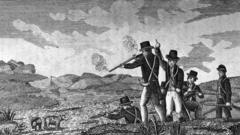
Trump's new take on 250 years of American expansionism
Summarized and contextualized by DistantNews.
At a glance
Analysis
Named sources
Context piece
- The United States has expanded significantly in its 250 years, growing from 13 colonies to a continental power with a population increase of over 8,000%.
- Historical divisions and debates over issues like slavery shaped the nation's early identity and political landscape.
- Professor Heather Cox Richardson and director Colin Woodard discuss how early American characteristics continue to influence the country's political outlook.
In its 250 years since independence, the United States has transformed from a small collection of settlements on the Atlantic coast into a vast continental power. Its geographic footprint has expanded eightfold, covering approximately 3.7 million square miles, while its population has surged by 8,475%, from about four million in 1790 to 343 million by 2025.
Despite this dramatic growth and change, the cultural and political influences that shaped the nation's early years remain recognizable. Historians note that many of President Donald Trump's key political stances, such as limiting immigration and asserting American power, echo the country's earliest distinctions and divisions.
Anybody who was looking at the colonies trying to create this nation is saying, all we need to do is stay over here and wait till they tear themselves apart and go back and pick them up.
America's founding was marked by intense debates over slavery, the constitution, and its economic and political systems, creating significant fractures. Even as the nation doubled in size with the Louisiana Purchase in 1803, its future remained uncertain, with some observers believing the colonies might collapse under internal pressures. However, the forces that would define the nation's trajectory were already in motion.
For them, freedom means maximising the autonomy and freedom of the individual and any growth in the power of government axiomatically means you know that individuals are less free.
Historians like Colin Woodard, director of the Nationhood Lab at Salve Regina University, identify distinct regional identities rooted in early settlement patterns. "Yankeeland" in the north reflects the influence of Puritan settlers and later German and Scandinavian immigrants, fostering a pluralistic outlook. In contrast, "Greater Appalachia" in the middle belt was settled by independent-minded Scots and Irish, whose historical experiences with English oppression instilled a deep suspicion of government authority.
Woodard explains that for these settlers, "freedom means maximising the autonomy and freedom of the individual and any growth in the power of government axiomatically means you know that individuals are less free." This contrasts sharply with the "Yankee Greater New England philosophy." Meanwhile, the Deep South was characterized by a landowning class with origins in slave plantations in the Caribbean, further contributing to the nation's complex and enduring regional divisions.
It is the opposite of the Yankee Greater New England philosophy.
DistantNews Editorial
Originally published by BBC News. Summarized and contextualized by our editorial team with added local perspective. Read our editorial standards.
More Stories


From Our Blog

What Gets Lost (and Found) When News Is Translated

The Critical Role of Diaspora Media in Global News

What Travellers Should Know About Countries with Restricted Press

A Digital Nomad's Guide to Following Local News

How the Same Story Looks Different in Different Countries
