


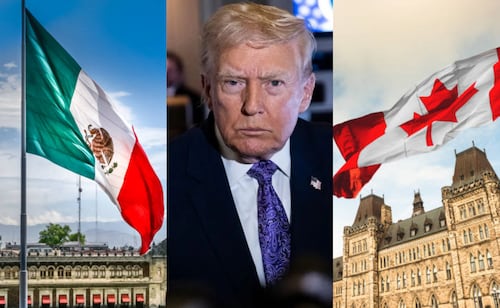
Trump says he'd prefer no USMCA, but is open to it; claims US would be better off without a deal
Translated from Spanish, summarized and contextualized by DistantNews.
At a glance
News
Named sources
Context piece
- Former U.S. President Donald Trump stated he would prefer the USMCA trade deal not exist but is open to signing it.
- Trump cited the North American Free Trade Agreement (NAFTA) as a poor deal and claimed the US would be better off without any agreement.
- The USMCA, which replaced NAFTA, is subject to a review six years after its implementation, a mechanism Trump pushed for.
Former U.S. President Donald Trump reiterated his preference for the United States to not have the USMCA trade agreement, though he indicated a willingness to sign it. Speaking to reporters at the G7 summit in Paris, Trump asserted that the country would be better off without the deal.
Trump explained that his push for the USMCA, during his first term, was partly because the preceding North American Free Trade Agreement (NAFTA) lacked an "exit clause." The USMCA, which took effect in July 2020, includes a provision for review six years after its implementation. Trump suggested that Mexico and Canada agreed to this mechanism anticipating he would no longer be in office by the time of the review.
"They expected I wouldn't be here," Trump remarked, expressing surprise at his continued presence in the White House. He repeated his stance that he "would prefer not to have an agreement, although it is possible that I will do it. We'll see what happens. Maybe we can't reach an agreement."
If the three countries do not agree to its continuation before July 1, the treaty will automatically extend for another 16 years. Otherwise, an annual review process could begin, potentially lasting a decade before expiration. Trump stated, "I prefer it to expire."
Mexico and Canada have publicly expressed their desire to renew the treaty for another 16 years.
DistantNews Editorial
Originally published by El Universal in Spanish. Translated, summarized, and contextualized by our editorial team with added local perspective. Read our editorial standards.
More Stories

From Our Blog

What Press Freedom Means for the News You Read

What Gets Lost (and Found) When News Is Translated

The Critical Role of Diaspora Media in Global News

What Travellers Should Know About Countries with Restricted Press

A Digital Nomad's Guide to Following Local News
