


🇹🇷
Turkey
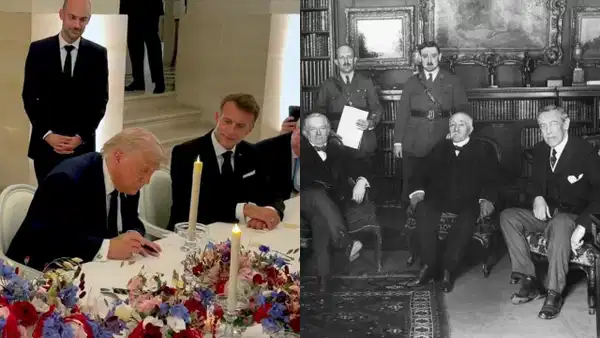
Trump, Wilson share historic venue for controversial deals
Translated from Turkish, summarized and contextualized by DistantNews.
At a glance
News
Sources not specified
Context piece
- A historical parallel is drawn between Donald Trump signing a US-Iran deal at the Palace of Versailles and Woodrow Wilson signing the Treaty of Versailles there 107 years prior.
- The Treaty of Versailles, signed in 1919, imposed harsh economic and political consequences on Germany, which historians link to the rise of Adolf Hitler.
- Wilson's efforts to get the US Senate to ratify the Treaty of Versailles failed, leading the US to sign a separate peace treaty with Germany in 1921.
The recent signing of a US-Iran memorandum of understanding by President Donald Trump at the Palace of Versailles has sparked historical parallels with a pivotal moment 107 years earlier. In 1919, then-U.S. President Woodrow Wilson signed the Treaty of Versailles in the same historic hall, an agreement that officially ended World War I but became one of history's most controversial peace treaties.
Historians note that the Treaty of Versailles imposed severe economic and political burdens on Germany. These included accepting responsibility for the war, ceding territory, paying substantial reparations, relinquishing colonies, and significantly limiting its armed forces. The treaty's terms, perceived as a "dictated peace" by Germany, generated widespread resentment and instability, which ultimately contributed to the rise of Adolf Hitler and the Nazi party.
The Treaty of Versailles, signed on June 28, 1919, at the Palace of Versailles in France, was prepared to end World War I.
Wilson's vision for the treaty included the establishment of the League of Nations, an international organization aimed at preventing future conflicts. However, this aspect faced strong opposition within the U.S. Congress. Critics feared that membership would entangle the United States in European disputes, leading to repeated failures in ratification votes in 1919 and 1920. Consequently, the U.S. never officially joined the League of Nations, signing a separate peace treaty with Germany in 1921.
Wilson embarked on an extensive campaign across the United States to garner support for the treaty. According to the Miller Center at the University of Virginia, his strenuous efforts during the summer of 1919 took a severe toll on his health. On October 2, 1919, Wilson suffered a debilitating stroke, significantly impairing his ability to fulfill his presidential duties for the remainder of his term. The echoes of Wilson's struggle to secure ratification resonate with the complexities surrounding international agreements and domestic political landscapes.
The conditions of the treaty caused great controversy from the moment it was signed.
DistantNews Editorial
Originally published by Cumhuriyet in Turkish. Translated, summarized, and contextualized by our editorial team with added local perspective. Read our editorial standards.
More Stories


From Our Blog

What Gets Lost (and Found) When News Is Translated

The Critical Role of Diaspora Media in Global News

What Travellers Should Know About Countries with Restricted Press

A Digital Nomad's Guide to Following Local News

How the Same Story Looks Different in Different Countries
