

Turkey's ancient oil wrestling festival Kırkpınar celebrates tradition and humility
Translated from English, summarized and contextualized by DistantNews.
At a glance
In-depth
Sources not specified
Context piece
- Turkey's Kırkpınar festival, a centuries-old oil wrestling tradition, is celebrated in Edirne.
- The festival is recognized by Guinness World Records as one of the oldest running festivals and is listed by UNESCO as Intangible Cultural Heritage.
- Wrestlers, known as 'pehlwans,' train rigorously and embody humility, with the sport shaping them into more patient and grounded individuals.
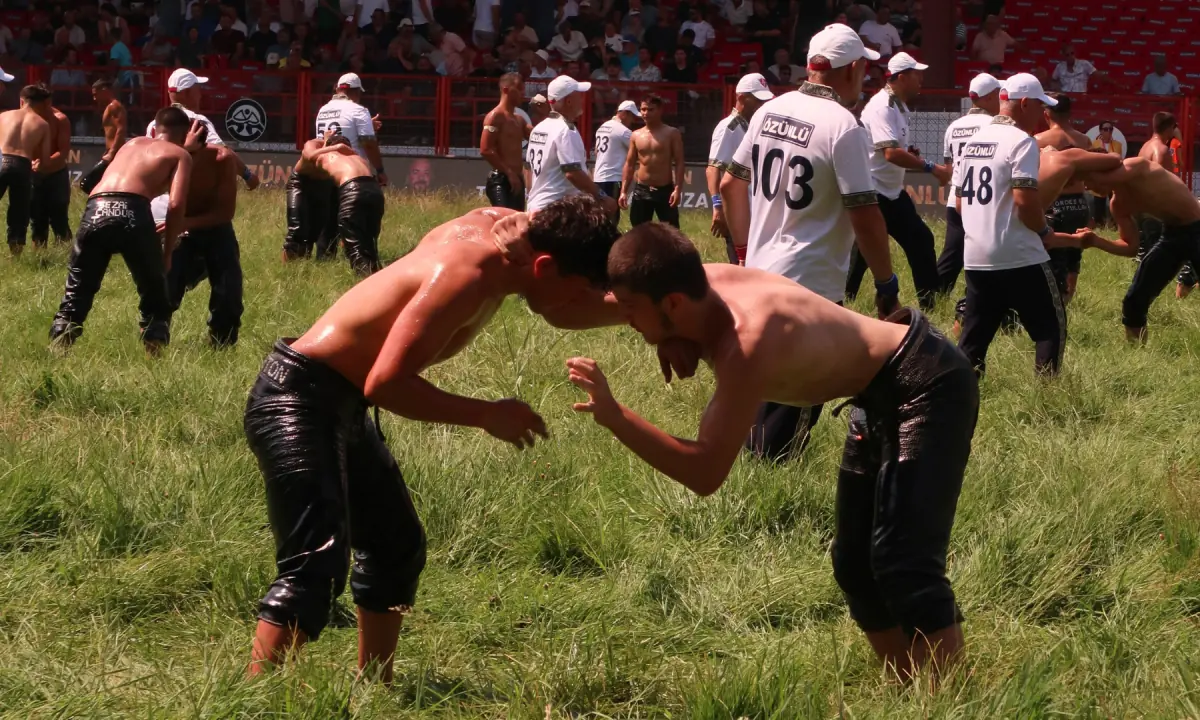
In the northwestern Turkish city of Edirne, the air crackles with anticipation for Kırkpınar, a legendary oil wrestling festival that has endured for over six centuries. This ancient tradition, known as yağlı güreş, is considered Turkey's national sport and predates the revival of the Olympics in 1896.
People say it’s all tall tales about the history of this festival. But whether you believe it or not, it’s all true.
The origins of Kırkpınar are steeped in legend. One tale recounts that in 1361, soldiers of Ottoman Sultan Orhan I discovered the springs after two brothers wrestled until they died of exhaustion. They were buried under a fig tree, and water sprang forth at the site, named Kırkpınar, or "Forty Springs." Today, the festival holds a place in global recognition, listed by Guinness World Records as one of the oldest continuously running festivals and by UNESCO as an Intangible Cultural Heritage of Humanity.
This 665-year-old cultural heritage doesn’t only hold importance for Türkiye, but also for the entire world.
Edirne Mayor Filiz Gencan Akın emphasizes the festival's global significance, stating, "This 665-year-old cultural heritage doesn't only hold importance for Türkiye, but also for the entire world." This year, the event has drawn 840 wrestlers, or 'pehlwans,' who prepare through months of demanding routines. Journalist Gökhan Tuzla, covering the festival for decades, notes that Kırkpınar cultivates more than just athletic prowess.
Kırkpınar does not produce champions. It produces ‘kibar adamlar’ (humble or refined men, depending on your semantics). You cannot wrestle in oil and leather under the sun in mud for three days straight and leave arrogant. The earth does not allow it.
"Kırkpınar does not produce champions," Tuzla explains. "It produces ‘kibar adamlar’ (humble or refined men). You cannot wrestle in oil and leather under the sun in mud for three days straight and leave arrogant. The earth does not allow it." Many pehlwans choose to camp in open-air grounds, feeling a deep connection to the earth. Muhammet Ali Karakuş, a 21-year-old wrestler from Antalya, shares how the sport has profoundly changed him: "Güreş (wrestling) has changed me as a person. I have become more patient, closer to nature. It has taught me what strength actually means."
Güreş (wrestling) has changed me as a person. I have become more patient, closer to nature. It has taught me what strength actually means.
DistantNews Editorial
Originally published by Dawn in English. Translated, summarized, and contextualized by our editorial team with added local perspective. Read our editorial standards.
More Stories

From Our Blog

What Gets Lost (and Found) When News Is Translated

The Critical Role of Diaspora Media in Global News

What Travellers Should Know About Countries with Restricted Press

A Digital Nomad's Guide to Following Local News

How the Same Story Looks Different in Different Countries
