


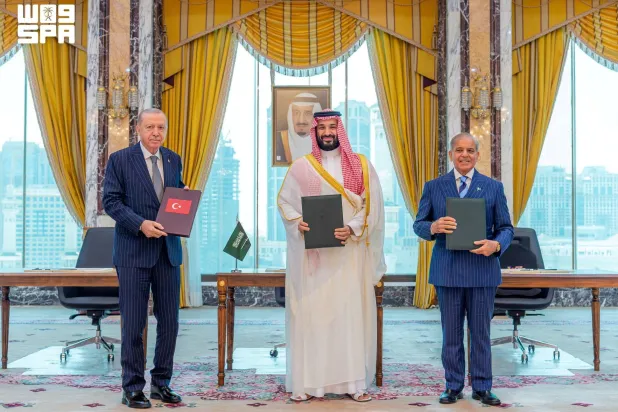
Türkiye, Saudi Arabia, Pakistan Ink 'Makkah Agreement' for Joint Defense
Translated from English, summarized and contextualized by DistantNews.
At a glance
News
Official statement
New plan
- Saudi Arabia, Türkiye, and Pakistan signed the 'Makkah Agreement for Joint Defense' to deepen military and defense industry cooperation.
- The pact establishes strategic political and military mechanisms involving defense ministers, foreign ministers, and military chiefs.
- The agreement emphasizes collective defense, considering an attack on one signatory as an attack on all, and is open to other countries.
Saudi Arabia, Türkiye, and Pakistan have formalized a new military pact, the 'Makkah Agreement for Joint Defense,' aiming to institutionalize and sustain defense and military ties between the regional powers. The agreement, signed in Makkah, establishes strategic political and military mechanisms that will involve the defense ministers, foreign ministers, and chiefs of general staff/armed forces commanders of the three nations, ensuring coordination at the highest level.
Under the accord, strategic political and military mechanisms plan to be established involving the Defense Ministers, Foreign Ministers, and Chiefs of General Staff/Armed Forces Commanders, and that coordination among the three countries will be conducted at the highest level.
The pact's fundamental goal is to strengthen joint deterrence and enhance defense coordination and integration. A key stipulation is the principle of collective defense: an armed attack against any one of the parties will be considered an attack against all three. This move is intended to bolster the security of the signatory nations and contribute to regional and international peace and stability.
The agreement is aimed at strengthening joint deterrence, as well as defense coordination and integration among the three countries.
Beyond immediate defense coordination, the agreement opens the door for practical structures and mechanisms in defense, including military, industrial, and technological cooperation. The signatories have emphasized that the Makkah Agreement is not intended as a closed alliance. Turkish President Recep Tayyip Erdogan stated the agreement is open to participation from all countries seeking peace and stability in the region. A Saudi official further clarified that the pact is not a military or sectarian bloc, nor is it tied to nuclear ambitions or an arms race, but rather focused on building sustainable defense capabilities.
It stipulates that an armed attack against any one of the parties will be considered an attack against all three, reinforcing the principle of collective defense against threats to their security.
The agreement was signed during a summit attended by Saudi Crown Prince and Prime Minister Mohammed bin Salman, Turkish President Recep Tayyip Erdogan, and Pakistani Prime Minister Shehbaz Sharif. The Turkish defense ministry announced on Thursday that senior ministers will group together, joint exercises will be held, and defense industry cooperation will deepen under the pact. The agreement also allows for the accession of other countries, contingent on the establishment of necessary institutional and regulatory mechanisms.
Saudi Arabia’s strategic ties with Gulf and Arab states or internation
DistantNews Editorial
Originally published by Asharq Al-Awsat in English. Translated, summarized, and contextualized by our editorial team with added local perspective. Read our editorial standards.
More Stories

From Our Blog

What Gets Lost (and Found) When News Is Translated

The Critical Role of Diaspora Media in Global News

What Travellers Should Know About Countries with Restricted Press

A Digital Nomad's Guide to Following Local News

How the Same Story Looks Different in Different Countries
