

Two Russians and a US astronaut fly to the ISS
Translated from German, summarized and contextualized by DistantNews.
At a glance
News
From a news agency
Outcome reported
- Two Russian cosmonauts and one US astronaut have successfully docked with the International Space Station (ISS) aboard a Russian Soyuz spacecraft.
- The arrival of the crew increases the ISS population to ten, with cooperation extended until 2030 despite geopolitical tensions.
- The mission highlights continued collaboration in space, with NASA and Roscosmos agreeing to extend joint operations.
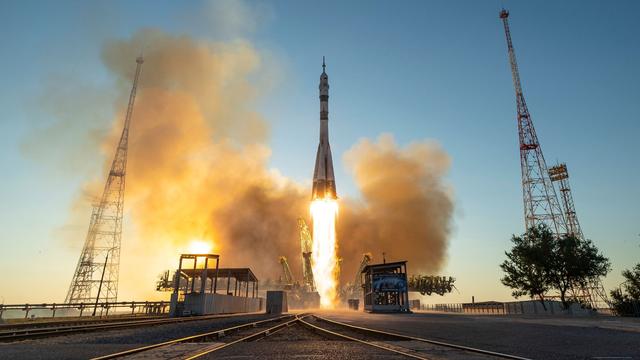
Despite ongoing geopolitical tensions stemming from the war in Ukraine, a joint mission has seen two Russian cosmonauts and one US astronaut successfully dock with the International Space Station (ISS). The Soyuz MS-29 spacecraft carrying cosmonauts Pyotr Dubrov and Anna Kikina, along with US astronaut Anil Menon, docked with the ISS module "Prichal" approximately three hours after launching from the Baikonur Cosmodrome in Kazakhstan.
This 75th mission to the ISS brings the total number of spacefarers aboard to ten. The crew joins US astronauts Jessica Meir, Jack Hathaway, and Chris Williams, French astronaut Sophie Adenot, and Russian cosmonauts Sergey Kud-Sverchkov, Sergey Mikayev, and Andrey Fedyaev, who were part of the preceding 74th mission. Notably, Anil Menon has Ukrainian roots.
The mission underscores a continued commitment to international cooperation in space. NASA Administrator Bill Nelson traveled to Baikonur to witness the launch, marking the first time in eight years a NASA chief attended a joint space mission launch with Russia at the site. Following discussions, NASA and Roscosmos have agreed to extend their collaboration on the ISS until 2030, according to Russia's Tass news agency. Roscosmos head Yuri Borisov also indicated that reciprocal flights to the ISS would continue until its operational end.
While NASA has plans for missions extending to 2032, Russia is reportedly planning to begin construction of its own space station in 2028, with operations potentially starting in the mid-2030s. The ISS, a collaborative project involving NASA, Roscosmos, the European Space Agency (ESA), and the space agencies of Canada and Japan, has been operational since 1998. However, cooperation has been strained since Russia's annexation of Crimea in 2014 and its full-scale invasion of Ukraine in 2022.
Today at 8:52 PM Moscow time (7:52 PM CEST), Soyuz MS-29 docked with the 'Prichal' module of the ISS.
DistantNews Editorial
Originally published by Die Zeit in German. Translated, summarized, and contextualized by our editorial team with added local perspective. Read our editorial standards.
More Stories



From Our Blog

What Gets Lost (and Found) When News Is Translated

How the Same Story Looks Different in Different Countries

The Critical Role of Diaspora Media in Global News

What Travellers Should Know About Countries with Restricted Press

A Digital Nomad's Guide to Following Local News
