


U.S. and Paraguay sign civil nuclear cooperation agreement
Translated from Spanish, summarized and contextualized by DistantNews.
At a glance
News
Official statement
New plan
- The United States and Paraguay signed a civil nuclear cooperation agreement, known as an "Article 123" agreement.
- The accord allows the U.S. to supply nuclear technology for peaceful purposes in exchange for adherence to IAEA standards and U.S. oversight.
- The signing occurred during a period of intensified cooperation between the Trump administration and Paraguay's conservative government.
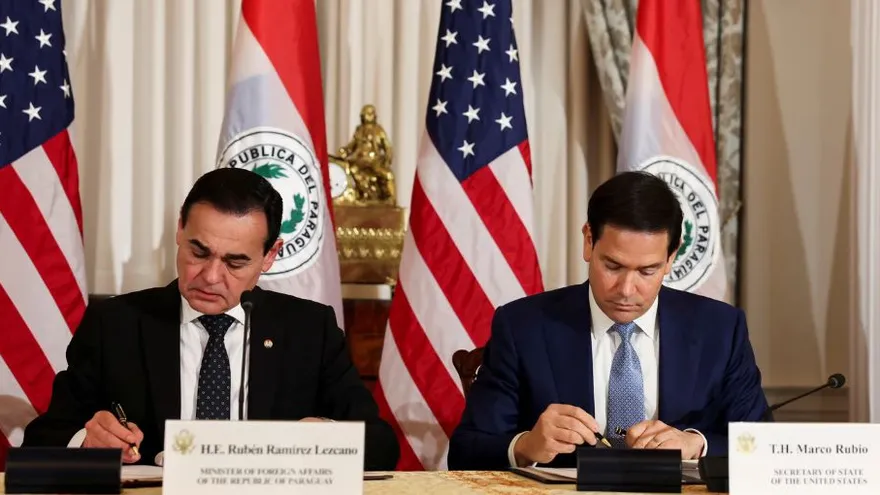
The United States and Paraguay have formalized a significant partnership by signing a civil nuclear cooperation agreement, commonly referred to as an "Article 123" agreement. U.S. Secretary of State Marco Rubio and Paraguayan Foreign Minister Rubén Ramírez executed the document in Washington.
This "Article 123" agreement, based on Section 123 of the U.S. Atomic Energy Act of 1954, enables the transfer of U.S. nuclear technology for civilian energy or scientific applications. In return, Paraguay commits to adhering to the International Atomic Energy Agency's (IAEA) standards and allows the U.S. to supervise the use of nuclear material, ensuring it is not diverted for military purposes. The U.S. has similar agreements with over 25 countries, including Argentina, Mexico, and Brazil.
What we are looking for is a relationship that not only continues to grow but is part of something that is permanent, and not subject to changes in government.
Rubio described the relationship between Washington and Asunción as "incredible" over the past year and a half, coinciding with the Trump administration's presence in the White House. He expressed a desire for a relationship that continues to grow and becomes permanent, rather than being subject to changes in government. This intensified cooperation reflects a broader trend of increased engagement between the conservative Paraguayan government, in power since 2023, and the Republican administration in the U.S., aligning with a perceived right-wing shift in Latin America.
Beyond nuclear cooperation, Rubio also met with Paraguayan Vice President Pedro Alliana. They discussed deepening security collaboration to combat transnational crime and terrorism threats. Additionally, Rubio spoke with President Santiago Peña, with both leaders emphasizing the importance of sustained regional unity and coordination, particularly concerning Venezuela. Washington and Asunción also jointly called for an extraordinary meeting of the Organization of American States (OAS) Permanent Council to address Nicaragua.
We are not only looking at the level of bilateral security cooperation, but also in our region.
DistantNews Editorial
Originally published by TVN Panamá in Spanish. Translated, summarized, and contextualized by our editorial team with added local perspective. Read our editorial standards.
More Stories

From Our Blog

What Gets Lost (and Found) When News Is Translated

The Critical Role of Diaspora Media in Global News

What Travellers Should Know About Countries with Restricted Press

A Digital Nomad's Guide to Following Local News

How the Same Story Looks Different in Different Countries
