


Unprecedented cosmic explosion in deep space: Gas shells ejected at 30 million kilometers per hour
Translated from Turkish, summarized and contextualized by DistantNews.
At a glance
News
Sources not specified
Context piece
- Astronomers discovered an unprecedented cosmic explosion from the V445 Puppis star system, ejecting gas at 30 million km/h.
- This "helium nova" is unique because it lacks hydrogen, with a white dwarf stealing helium from a companion star.
- Observations using the James Webb Space Telescope will further investigate the event's role in the universe's chemical evolution.
Astronomers have identified an extraordinary cosmic event in the depths of space: an unprecedented explosion from the V445 Puppis star system that is ejecting gas at a staggering speed of 30 million kilometers per hour. This discovery, stemming from the study of stellar evolution, is poised to significantly advance our understanding of the universe's structure.
The V445 Puppis system is notable for being the only confirmed "helium nova" in scientific literature. Unlike standard novae, which occur when a white dwarf accumulates hydrogen from a companion star and ignites it in an explosion, this system is characterized by a near-complete absence of hydrogen. Instead, research presented at the Royal Astronomical Society's National Astronomy Meeting in the UK revealed that a massive white dwarf is continuously drawing matter from a helium star companion.
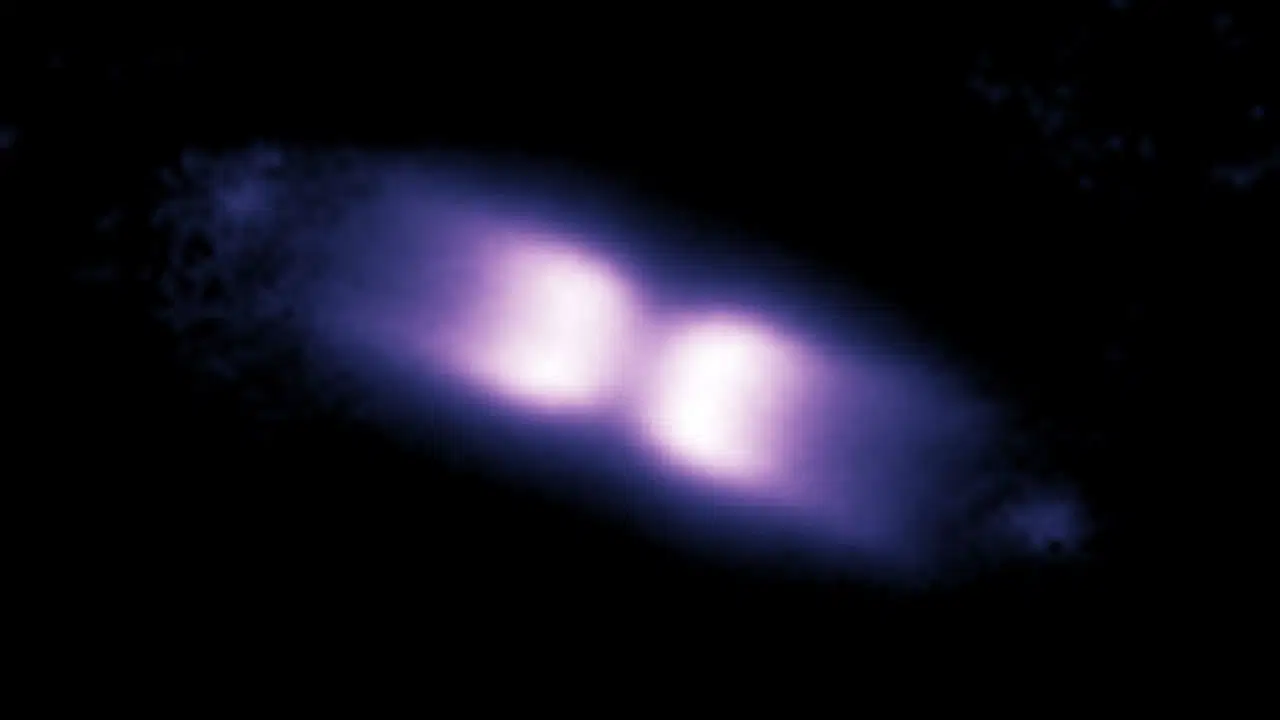
Researchers determined that the two stars orbit each other every 3.7 days. This rapid mass transfer has resulted in a rare helium explosion on a cosmic scale. Following the blast, scientists observed the star ejecting gas in two lobes. Within these lobes, they identified dense gas masses, termed "projectiles," composed primarily of oxygen.
Dr. John Mills, the lead researcher, stated that these oxygen-rich projectiles are being launched into space at an incredible velocity exceeding 30 million kilometers per hour. This observation marks the first time in astronomical history that such high-speed, oxygen-dense mass ejections have been witnessed from a nova. The event coincided with a mysterious, simultaneous radio burst detected across space, adding to the scientific excitement.
After being obscured by a dense dust cloud for approximately 25 years, V445 Puppis has now become a vast laboratory for astrophysicists. Experts emphasize the critical role novae play in the universe's chemical evolution, often overshadowed by supernovae. New observation programs are underway to analyze the mass accumulation and radiation within the system. Future studies using the James Webb Space Telescope will examine the star's core structure behind the dust layer in infrared wavelengths, while ultraviolet and X-ray telescopes will track how heavy elements and oxygen are dispersed into interstellar space, crucial for understanding the origins of life.
these gas projectiles, extremely rich in oxygen, are being launched into space at an incredible speed exceeding 30 million kilometers per hour.
DistantNews Editorial
Originally published by Cumhuriyet in Turkish. Translated, summarized, and contextualized by our editorial team with added local perspective. Read our editorial standards.
More Stories



From Our Blog

What Gets Lost (and Found) When News Is Translated

The Critical Role of Diaspora Media in Global News

What Travellers Should Know About Countries with Restricted Press

A Digital Nomad's Guide to Following Local News

How the Same Story Looks Different in Different Countries
