

Upper Rhine Shipping Crippled by Low Water: 'No Water Here,' Says Barge Captain
Translated from German, summarized and contextualized by DistantNews.
At a glance
News
Named sources
Context piece
- Barges on the Upper Rhine River are navigating extremely low water levels, significantly impacting shipping.
- Captain Patrick Mnich reports his vessel, the GMS Kallisto, is struggling to maintain speed and is at risk of grounding.
- Reduced cargo loads, with ships carrying only about 10% of capacity, are necessary due to the low water, affecting transport of goods like wind turbine parts.
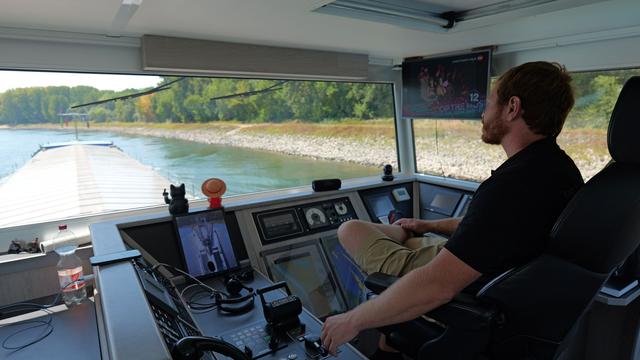
Barge captain Patrick Mnich describes the critical situation on the Upper Rhine River, where extremely low water levels are severely hindering navigation. "There is no water," Mnich stated, explaining that his vessel, the GMS Kallisto, cannot achieve adequate speed because the propeller lacks sufficient water depth. He reported that at times, only 30 to 40 centimeters of water lie between his ship's hull and the riverbed, forcing him to slow down to avoid churning up gravel and potentially getting stuck.
The low water levels, which have persisted since early June according to the Upper Rhine Waterways and Shipping Office (WSA), are attributed to a lack of snowmelt and insufficient rainfall. No immediate improvement is forecast. Mnich, transporting wind turbine components from Magdeburg to Kehl, is experiencing significant delays. He noted that the section of the Rhine near Mannheim was particularly challenging, causing him to slide over a gravel bank.
The impact of the low water is starkly illustrated by Mnich's cargo. His ship, capable of carrying 1,570 tons, is currently loaded with only 150 tons, about 10% of its capacity. This drastic reduction is necessary to prevent the vessel from sitting too low in the water. The Baden-Württemberg Ministry of Transport confirmed that nearly all shipments are currently restricted to reduced loads, with maximum capacity utilization at around 20%.
While Mnich's 80-meter GMS Kallisto, with its relatively low draft, can still navigate, larger vessels face greater challenges. His brother, also a barge captain, is reportedly stranded in Duisburg because his ship would sit too deep in the water. The situation underscores the vulnerability of inland waterway transport to climate-induced water scarcity.
DistantNews Editorial
Originally published by Die Zeit in German. Translated, summarized, and contextualized by our editorial team with added local perspective. Read our editorial standards.
More Stories
From Our Blog

What Gets Lost (and Found) When News Is Translated

How the Same Story Looks Different in Different Countries

The Critical Role of Diaspora Media in Global News

What Travellers Should Know About Countries with Restricted Press

A Digital Nomad's Guide to Following Local News
