


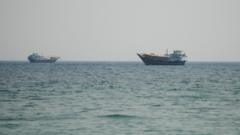
US and Iran trade fire as tensions rise over Strait of Hormuz
Summarized and contextualized by DistantNews.
At a glance
News
Sources not specified
Ongoing story
- The U.S. and Iran have engaged in escalating missile and drone attacks, with Iran claiming to have closed the Strait of Hormuz.
- The heightened conflict jeopardizes a recent interim agreement aimed at reopening the vital waterway and ending the war.
- Oil prices surged as traders reacted to the intensified hostilities and uncertainty surrounding the Strait of Hormuz.
The United States launched a new attack on Iran Sunday evening, continuing a cycle of strikes between the two nations. Iranian state media reported casualties, with one person killed and four injured in southwestern Iran. Within hours, Iran's Islamic Revolutionary Guard Corps (IRGC) claimed to have struck U.S. military bases in Kuwait, Jordan, and Bahrain, marking a significant escalation.
These escalating attacks cast doubt on the future of an interim U.S.-Iran agreement signed in June, which aimed to reopen the Strait of Hormuz and eventually end the conflict. Conflicting claims have emerged regarding the status of the strait, with Iran asserting it is closed indefinitely while the U.S. insists it remains open. U.S. Central Command (Centcom) announced further strikes targeting Iranian military assets, including air-defense systems and missile capabilities, stating their preparedness to ensure freedom of navigation.
Iranian state television reported explosions in several port cities, and IRNA cited a local official confirming casualties from the U.S. strikes. The renewed hostilities have already impacted global markets, with oil prices jumping significantly on Monday. Brent crude rose by 4.3% to $79.26 a barrel, and U.S.-traded oil also saw a 4.3% increase to $74.50. Energy prices have been volatile in recent months due to developments in the conflict.
The conflict's origins trace back to February 28, when the U.S. and Israel attacked Iran, leading to Tehran effectively closing the Strait of Hormuz, a critical route for approximately 20% of the world's oil and LNG shipments. The IRGC's retaliatory attacks targeted U.S. bases and allies across the region, including Qatar and the UAE. U.S. President Donald Trump had previously declared the ceasefire over, while Iran's Foreign Minister Abbas Araghchi accused the U.S. of violations.
DistantNews Editorial
Originally published by BBC News. Summarized and contextualized by our editorial team with added local perspective. Read our editorial standards.
More Stories


From Our Blog

What Gets Lost (and Found) When News Is Translated

The Critical Role of Diaspora Media in Global News

What Travellers Should Know About Countries with Restricted Press

A Digital Nomad's Guide to Following Local News

How the Same Story Looks Different in Different Countries
