


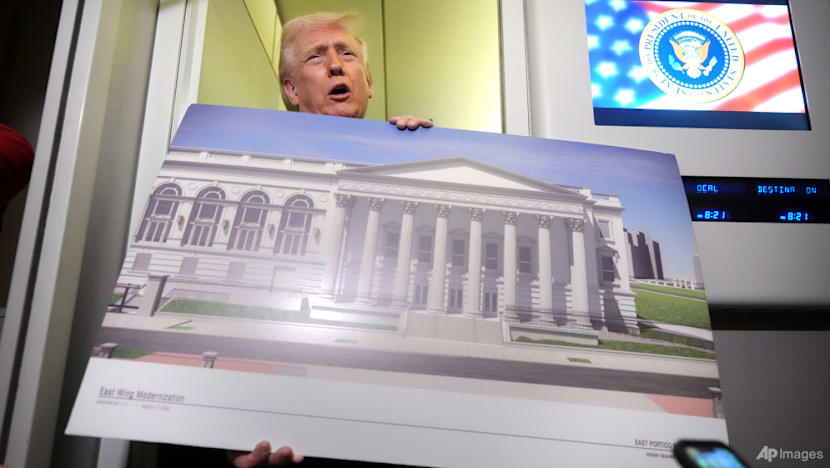
US appeals court blocks Trump’s US$400 million White House ballroom project
Summarized and contextualized by DistantNews.
At a glance
News
Named sources
In the courts
- A U.S. federal appeals court blocked the Trump administration's $400 million White House ballroom project.
- The court upheld a preliminary injunction, ruling the administration needed congressional authorization for construction.
- The decision is a setback for Trump's efforts to reshape Washington D.C.'s landscape and is subject to further appeal.
A U.S. federal appeals court delivered a significant setback to President Donald Trump's administration on August 7, 2026, by ordering a halt to the construction of a $400 million ballroom on the site of the White House's demolished East Wing. The ruling by the U.S. Court of Appeals for the District of Columbia Circuit, in a divided 2-1 decision, upheld a preliminary injunction previously granted to the National Trust for Historic Preservation.
no federal statute “comes close to giving the president” the required authority to construct the ballroom without congressional approval.
The preservation group sued after the administration demolished the East Wing and began constructing the 8,360-square-meter ballroom without seeking authorization from Congress. The appeals court has placed its ruling on hold for 14 days, allowing the Trump administration an opportunity to appeal to the U.S. Supreme Court. This legal battle tests the limits of presidential authority in reshaping federal property.
U.S. District Judge Richard Leon had twice blocked above-ground construction, though he permitted underground work to continue. Leon, appointed by former Republican President George W. Bush, ruled that no federal statute granted the president the authority to construct such a ballroom without congressional approval. The administration argued the ballroom was necessary for large formal functions and to enhance White House security.
They just don't want to go to Congress
This ballroom plan is the most ambitious of several Trump initiatives aimed at altering central Washington's landscape of government buildings and national monuments. In a separate case, a judge recently ruled that Trump's name was illegally added to the exterior of the Kennedy Center and ordered its removal. Justice Department attorney Yaakov Roth argued during circuit court arguments that courts should not interfere with the privately funded project and that blocking it was improper. Roth contended that the National Trust's "architectural preference" should not override national security concerns, claiming the former East Wing left the president and White House staff vulnerable to attack. Thaddeus Heuer, a lawyer for the preservation group, countered that the administration simply "just don't want to go to Congress."
it is approximately twice the size, and a far higher quality, than the original proposal and promised 'it will be magnificent, safe, and secure!'
DistantNews Editorial
Originally published by CNA. Summarized and contextualized by our editorial team with added local perspective. Read our editorial standards.
More Stories



From Our Blog

What Gets Lost (and Found) When News Is Translated

The Critical Role of Diaspora Media in Global News

What Travellers Should Know About Countries with Restricted Press

A Digital Nomad's Guide to Following Local News

How the Same Story Looks Different in Different Countries
