


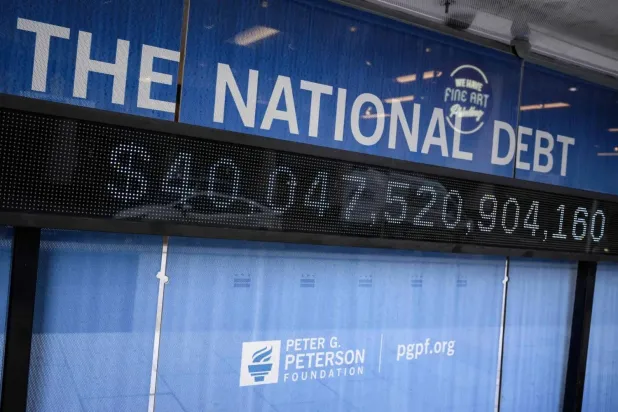
US Debt Hits $40 Trillion as Higher Yields Open New Opportunities for Gulf Investors
Summarized and contextualized by DistantNews.
At a glance
News
Named sources
Context piece
- US debt has surpassed $40 trillion, prompting Gulf investors to analyze its broader implications for capital flows and investment strategies.
- Despite the rising debt, US assets and the dollar remain central to Gulf portfolios due to market depth and currency links, with higher yields offering new investment opportunities.
- Economists note that the Gulf's strong financial position provides flexibility in navigating global interest rate shifts, encouraging diversified investment strategies.
As the United States grapples with a national debt exceeding $40 trillion, investors in the Gulf are closely examining the implications beyond the headline figure. They are focusing on how rising Treasury yields influence capital flows, financing costs, and their own investment strategies.
US debt reaching $40 trillion does not pose an “immediate risk” to Gulf dollar-denominated investments, although it increases longer-term structural risks monitored by sovereign wealth funds and central banks.
US assets and the dollar continue to be a cornerstone of Gulf investment portfolios. This is attributed to the deep and liquid American markets, as well as the established links between Gulf currencies and the dollar. The current environment of higher yields presents a strategic opportunity for Gulf sovereign wealth funds to rebalance their portfolios and potentially achieve stronger returns on new investments. Economists suggest that the robust financial standing of the Gulf region equips it with significant flexibility to manage fluctuations in global interest rates.
Abdullah Almeer, an economics professor at King Fahd University of Petroleum and Minerals, stated that while the $40 trillion debt figure does not pose an immediate risk to Gulf investments denominated in dollars, it does introduce longer-term structural risks that require monitoring by sovereign wealth funds and central banks. He noted that Saudi Arabia holds approximately $142 billion in US Treasury securities, reinforcing the dollar's sustained importance in the global financial system, where it constitutes about 57% of central bank reserves.
Saudi Arabia holds about $142 billion in US Treasury securities, while the dollar accounts for roughly 57% of global central bank reserves, underscoring its continued central role in the international financial system.
While the doubling of US debt warrants careful observation of fiscal developments, Almeer argued that it is unlikely to diminish the attractiveness of US markets or the dollar's significance to Gulf economies in the foreseeable future. He also dismissed the possibility of a large-scale Gulf exit from US assets. The primary impact on Gulf economies is expected through interest rates, as the substantial issuance of Treasury debt needed to finance the national debt could drive yields higher, especially if inflation persists or oil prices increase. Saudi Arabia's currency peg to the dollar means its monetary policy is closely tied to US interest rates, and a widening rate differential could pressure the exchange rate and capital flows.
The doubling of US debt from about $20 trillion in 2016 to more than $40 trillion today warrants closer scrutiny of fiscal developments, but does not, for the foreseeable future, diminish the attractiveness of US markets or the dollar’s importance to Gulf economies, he argued.
DistantNews Editorial
Originally published by Asharq Al-Awsat. Summarized and contextualized by our editorial team with added local perspective. Read our editorial standards.
More Stories


From Our Blog

What Gets Lost (and Found) When News Is Translated

The Critical Role of Diaspora Media in Global News

What Travellers Should Know About Countries with Restricted Press

A Digital Nomad's Guide to Following Local News

How the Same Story Looks Different in Different Countries
