


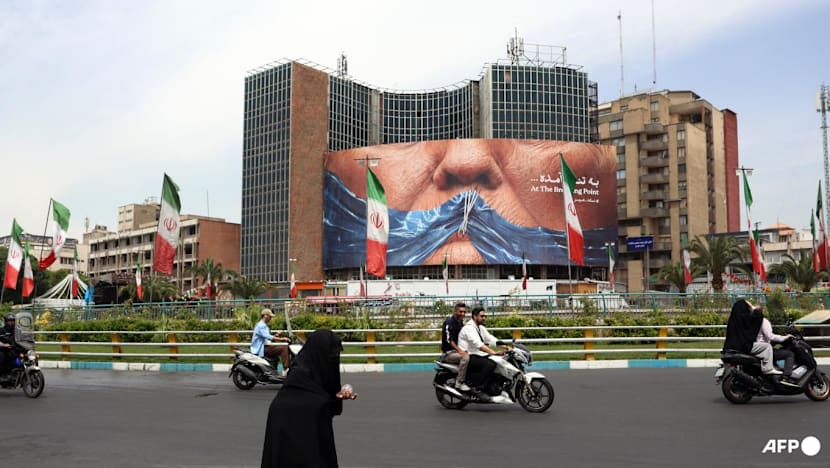
US, Iran Trade Defiant Rhetoric as New Sanctions Loom, Strait of Hormuz Traffic Halts
Translated from English, summarized and contextualized by DistantNews.
At a glance
News
Named sources
Ongoing story
- The U.S. and Iran are exchanging defiant rhetoric ahead of new U.S. economic sanctions scheduled for Monday, August 24.
- Oil shipments through the Strait of Hormuz have significantly decreased as Iran threatens to impede transit.
- The U.S. aims to impose "the toughest sanctions in history" on Iran, urging China to cooperate.
The United States and Iran are locked in a war of words ahead of Monday's scheduled announcement of new U.S. economic sanctions, which are expected to heavily impact the Islamic Republic and its key trading partners, notably China. With the conflict nearing its six-month mark, neither side is pursuing peace talks, while Iran continues to leverage its position by threatening to disrupt oil shipments through the vital Strait of Hormuz.
the toughest sanctions in history
U.S. Treasury Secretary Scott Bessent is set to unveil what are described as "the toughest sanctions in history" against Iran. Washington is also pressing China, which imports over 80% of Iran's shipped oil, to align with its policy. Beijing, however, has called for diplomacy.
Iran's Foreign Ministry spokesperson, Esmaeil Baghaei, criticized the impending U.S. sanctions as an "assertion of extraterritorial sovereignty over every independent member state of the United Nations," arguing they lack a basis in international law. U.S. President Donald Trump reiterated his stance, warning of economic consequences for any nation aiding Iran and expressing doubt that Iran is ready to negotiate a "right deal."
Such secondary sanctions find no foundation in international law
The Strait of Hormuz has seen a dramatic reduction in traffic, with only a handful of commodity ships transiting recently, down from millions of barrels per day before the war. U.S. Energy Secretary Chris Wright noted that U.S. military actions previously helped secure the passage of 8 million barrels of oil daily through the strait, a figure that has plummeted. Despite significant damage to Iran's economy, navy, and air force from U.S. attacks, Tehran retains missile and drone capabilities to impede maritime traffic and strike regional adversaries.
They would love to make a deal, but they're not ready to make the right deal, in my opinion
President Trump's initial objectives, including dismantling Iran's nuclear program and facilitating the overthrow of its clerical rulers, remain unachieved. The war has resulted in thousands of casualties, including 168 Iranian schoolchildren on the first day alone, and over 750 U.S. military personnel wounded, with 18 killed. Iran's chief of staff of the armed forces has vowed a military response to any threats.
Iran would respond to enemy threats militarily
DistantNews Editorial
Originally published by CNA in English. Translated, summarized, and contextualized by our editorial team with added local perspective. Read our editorial standards.
More Stories
From Our Blog

What Gets Lost (and Found) When News Is Translated

The Critical Role of Diaspora Media in Global News

What Travellers Should Know About Countries with Restricted Press

A Digital Nomad's Guide to Following Local News

How the Same Story Looks Different in Different Countries
