


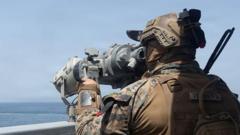
US military strikes Iranian drones and radar sites near Strait of Hormuz
Translated from English, summarized and contextualized by DistantNews.
At a glance
News
Official statement
Ongoing story
- The US military announced it shot down four Iranian drones targeting the Strait of Hormuz, deeming them an immediate threat to maritime traffic.
- In response, US forces struck Iranian coastal radar sites on Goruk and Qeshm Island to prevent further attacks.
- The incident follows recent escalations between the US and Iran, occurring as ceasefire negotiations between the two nations have stalled.
The US military reported on Friday that it intercepted and destroyed four Iranian "one-way attack drones" launched toward the Strait of Hormuz. US Central Command (Centcom) stated the drones posed an immediate threat to regional maritime traffic. Following the drone incident, US forces subsequently targeted Iranian coastal surveillance radar sites in Goruk and on Qeshm Island, aiming to defend against potential future attacks.
This confrontation marks another escalation in tensions between Washington and Tehran, occurring just days after a previous exchange of strikes that jeopardized a fragile ceasefire. Iran has not yet issued a public statement regarding this latest incident. The situation is particularly sensitive as ceasefire negotiations between the US and Iran have reportedly stalled, with no significant progress on a deal to end the ongoing conflict.
posed an immediate threat to regional maritime traffic
The Strait of Hormuz is a critical chokepoint for global energy supplies, with approximately 20% of the world's oil and liquefied natural gas passing through it. Previous Iranian actions to disrupt shipping in the strait have sent oil prices soaring. The US has maintained a blockade of Iranian ports, which President Donald Trump has vowed to continue until a comprehensive agreement is reached and signed.
to defend against further attacks
DistantNews Editorial
Originally published by BBC News in English. Translated, summarized, and contextualized by our editorial team with added local perspective. Read our editorial standards.
More Stories


From Our Blog

What Gets Lost (and Found) When News Is Translated

The Critical Role of Diaspora Media in Global News

What Travellers Should Know About Countries with Restricted Press

A Digital Nomad's Guide to Following Local News

How the Same Story Looks Different in Different Countries
