

US reassures Gulf allies on security, Iran deal during Rubio's regional tour
Translated from English, summarized and contextualized by DistantNews.
At a glance
News
Sources not specified
New plan
- US Secretary of State Marco Rubio met with leaders in the UAE and Kuwait to discuss the US-Iran deal and reaffirm security commitments.
- Rubio sought to reassure allies concerned about the recent Iran agreement, particularly regarding Iran's missile program.
- He also asserted that no country can impose tolls on the Strait of Hormuz, citing international law.
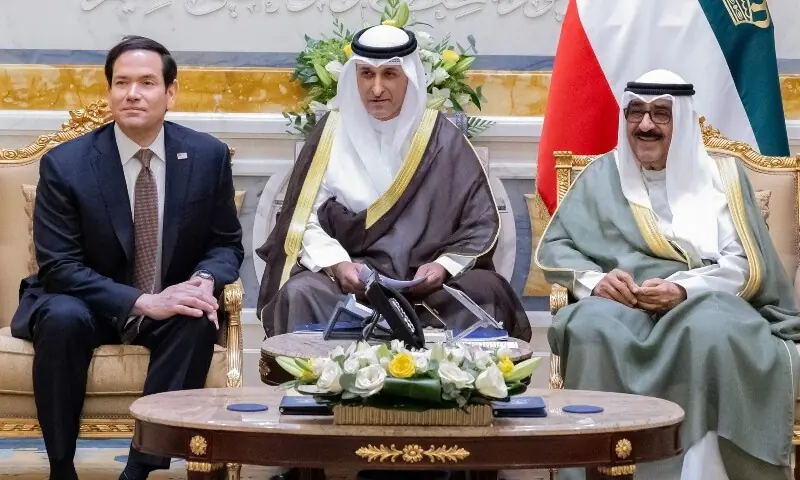
U.S. Secretary of State Marco Rubio embarked on a regional tour to reassure Gulf allies of America's security commitments, following the recent US-Iran deal. His visit to the UAE and Kuwait marked the first by a senior U.S. official to the Middle East since the agreement was signed.
They discussed President Trump’s memorandum of understanding with Iran, efforts to secure full and safe transit through the Strait of Hormuz, and the importance of peace and stability in the region.
Rubio's primary objective was to address lingering concerns among U.S. allies regarding the memorandum of understanding with Tehran. These allies have long worried about Iran's missile program, an issue not fully covered by the deal. The secretary of state engaged in closed-door discussions with leaders, including UAE President Sheikh Mohamed bin Zayed Al Nahyan, to explain Washington's position.
During his visit, Rubio also firmly stated that no nation would be permitted to charge tolls on the Strait of Hormuz. He emphasized that the waterway is international and subject to existing international law, pushing back against recent suggestions by Oman and Iran to levy fees on ships transiting the crucial oil and gas route.
It’s an international waterway. No country is allowed to charge tolls or fees on an international waterway. That’s existing international law.
The U.S. diplomat's mission is considered delicate, as he must defend the Trump administration's accord while acknowledging and attempting to alleviate the disquiet of key regional partners. His remarks are expected to be closely watched for how he frames the deal, particularly given past criticisms of Iran from within the U.S. Congress.
That most certainly will come up in these discussions.
DistantNews Editorial
Originally published by Dawn in English. Translated, summarized, and contextualized by our editorial team with added local perspective. Read our editorial standards.
More Stories

From Our Blog

What Gets Lost (and Found) When News Is Translated

The Critical Role of Diaspora Media in Global News

What Travellers Should Know About Countries with Restricted Press

A Digital Nomad's Guide to Following Local News

How the Same Story Looks Different in Different Countries
